


Stories you may like
Homeopuncture
Homeopuncture (or Homeosiniatry) is an alternative medicine practice that merges homeopathy and acupuncture, delivering homeopathic remedies directly into acupuncture points using needles to stimulate healing by combining energetic points with specific diluted substances for holistic treatment. Practitioners use a needle dipped in a chosen homeopathic medicine to puncture specific points, aiming for faster, deeper effects on chronic or acute conditions, and it's taught in various alternative health courses.
Homeopuncture is a methodology by which the specific homeopathic remedy is placed directly in the tissue by first dipping an acupuncture needle in the remedy & then puncturing at the specific points.
BENEFITS
Homeopuncture has the following advantages: 1) Normally in homeopathy, the remedy is placed under the tongue (liquid) or swallowed as a tablet. But in homeopuncture the remedy is placed directly in the tissue. The saliva and other oral barriers are avoided (bypassed). 2) Action is direct and immediate. 3) The complementary action of acupuncture therapy helps to enhance the cure. No two patients with headache require the same medicine. Each one's headache has its own peculiar symptoms and therefore its own remedies, e.g. headache from dental amalgam, use Mercurius solubis 30C. One major advantage of homeopathy is its safety. While its medicines are powerful in action working with the body's own defense, their actual measurable strength is too low to give rise to the undesirable side effects that many modern drugs produce in orthodox medicine.
- Needling Technique: An acupuncture needle is dipped in the diluted remedy and inserted into the chosen point, delivering the medicine directly into the body's energetic system.
- Integration of Disciplines: It combines the principles of acupuncture (energy meridians, specific points) with homeopathy (potentized remedies).
- Application: A practitioner selects a homeopathic remedy and a specific acupuncture point relevant to the patient's condition
.
Acupuncture and homeopathy have been separated by time and land. They are different branches of the healing tree. Their methods seem totally different from one another. Both protocols recognize that within the person energies/forces exist and are constantly in motion. Hannaman, the founder of homeopathy, spoke of the vital force, while the acupuncturist (Traditional Chinese Medicine) practitioner spoke of Qi (pronounced 'chi') many centuries ago.
Both treatment protocols are known to treat a wide array of illnesses, and provide cures when practised. Acupuncture uses very fine needles (which are seldom painful) to stimulate certain points along the meridians. These points, once stimulated, can produce varying results from pain relief to reviving patients. Its efficiency is in bringing to a normalcy the imbalance that is present in the body. With proper diagnosis, using Traditional Chinese Diagnosis, a practitioner is able to understand where and what the disorders are, and formulate the best action plan to treat it.
Homeopathy also recognizes the importance of treating individuals as individuals and of understanding the whole person, as opposed to only understanding a single disease. Therefore, a typical examination would include history taking and examination, as they are all important in establishing the diagnosis. This makes it easy to understand what the true cause of the disorder is. Homeopathy treats by reportizing the patient's case, thus taking into consideration the patient's condition, personality, physical features, effects of external factors, such as environment, nature and time, and patterns of disease within the family. This approach makes it possible to cure any condition, but not many people will admit to that.
Homeopathy and Acupuncture
Both modalities of treatment can be combined and delivered in their original form to complement each other by practitioners trained in both arts.
Homeosiniatry
Homeopaths Weihe (of German descent) and Goehrum discovered that when certain diseases were cured by a homeopathic remedy, a point in the body that grew tender with pressure was relieved. During his research, Weihe was able to locate approximately 197 points. He also linked these points with particular homeopathic remedies which were prescribed for a specific disorder. He was able to use the points to confirm the correct remedy to prescribe when in doubt. This was known as Homeosiniatry. Strangely enough, these tender points are also described in TCM as Alarm points and As-shi points. Alarm points represent organs in the body. If there is a disorder in the organ's related energy channel, the respective alarm point will become tender.
Homeopuncture
Subsequently, a famous French author and acupuncturist, Roger de la Fuye (French Homeopath and Acupuncturist) researched and concluded that homeopathy can be used with acupuncture to treat patients. He was also able to utilize the points to confirm if the remedy was the proper one.
Considering the effectiveness of each therapy, it is fair to say that combining these two therapies could be very fruitful.
Homeopuncture in Practice
Using homeopathy with acupuncture has brought about a union of the knowledge between the healing methods of acupuncture and homeopathy. Both treatment methodologies have shown their value in treating many disorders, and so in combination they can make possible even greater feats.
If an acupuncturist were to say "why bother… acupuncture can do anything", this would only indicate ideological rigidity, and they would have failed to see that the idea of any treatment is to heal the patient as soon as possible and as effectively as possible. In combining the knowledge of the two systems, we become equipped to have a better understanding about the patient and the illness. This enables practitioners to treat patients more efficiently.
Clinical Homeopuncture
In recent years, the combination of acupuncture and homeopathy has revealed success in treating conditions that range from alopecia areata (hair loss) and skin disorders, such as leucoderma (Vitiligo) and psoriasis, to arthritis and many other conditions.
The Procedure
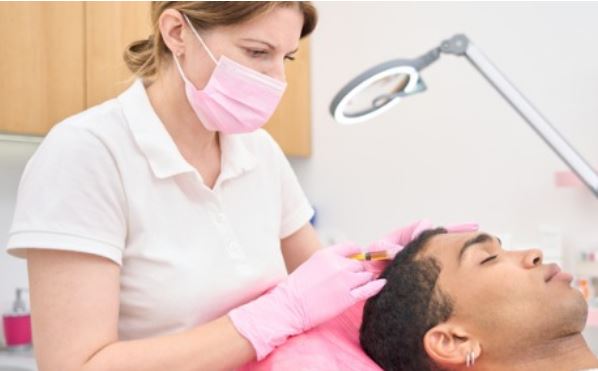
The needles are immersed in a liquid homeopathy remedy. The acupuncturist uses normal needling, or non-retention needling (in disorders that cover a greater area), on the affected area (in Chinese 'Ashi points'). 'Non-retention needling' is the use of acupuncture needles to puncture the skin and then removing it, instead of letting the needle remain in the skin as it normally would be. This is continued until the affected area has been completely pricked with the needle. After every one or two pricks, the homeopath lubricates the needle tip before puncturing the skin again. This might sound very painful, but in fact if you go to an experienced acupuncturist you will experience no pain or minimal discomfort, depending on the location being needled.
Advantages
1. Nil or Minimal Aggravation
Since acupuncture has a homeostatic quality, if there is any aggravation that occurs with homeopathy, it is completely exhausted or brought to a minimum;
2. On Remedies
Some remedies might case side-effects because it is not the similimum. Even though this is the case, for homeopuncture one may choose to use a remedy that has a direct influence on the disorder, and focuses only on the disorder. Since both treatment protocols are natural, and treat the body as a whole, it may be a good idea to divide the forces. For example, a homeopathic remedy can be prescribed for the disease only, coupled with acupuncture using the regular points for the disorder (with Du20 BaiHui). The result, on many occasions, is that there are no aggravations;
3. The Remedy Remains Pure
As the remedy is directly inserted into certain areas of the body, there is a smaller chance of contamination then when given orally;
4. On Potencies
Combinations of potencies can be used, by having one potency for the homeopuncture, where the remedy reaches the patient via the needle, and another in the traditional homeopathic manner. Why? Because the homeopuncture remedy will act, for example, in Leucoderma; instead of using the similimum you may choose Sepia 6c or 12c with the needles and give the similimum in the oral form.
- Holistic Healing: Aims to balance the body's energy (Qi) and promote self-healing.
- Enhanced Efficacy: Believed to offer faster and more profound results than either therapy alone, according to its proponents.
- Non-Invasive: Falls under natural, non-synthetic treatment approaches.







User's Comments
No comments there.