


Stories you may like
How Businesses Use AI to Scale Faster and Smarter
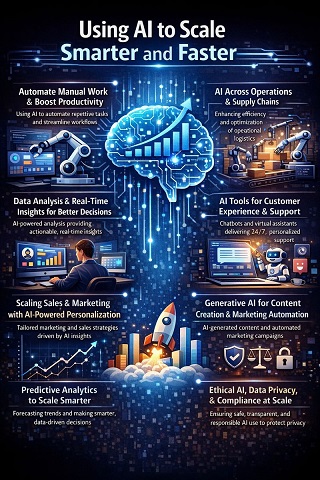
Artificial intelligence is no longer limited to large enterprises with massive budgets. Today, small and medium enterprises, mid-sized businesses, and fast-growing startups are adopting AI to accelerate growth, improve productivity, and compete more effectively. From automation and data analysis to personalization at scale, AI is changing how companies operate and how businesses scale without adding unnecessary complexity or manual work.
As AI technology becomes more accessible, businesses can use AI to scale smarter, make better decisions, and unlock new opportunities across sales and marketing, operations, and customer experience.
1.Using AI to Automate Manual Work and Boost Productivity
One of the most immediate ways businesses use AI is through automation. Many processes that once required hours of manual work can now be handled by an AI system, freeing teams to focus on higher-value tasks.
AI tools like chatbots, workflow automation platforms, and intelligent assistants help businesses respond to customer inquiries, manage internal processes, and handle repetitive tasks efficiently. Small business owners often adopt AI tools to manage scheduling, invoicing, and customer support without hiring additional staff.
Automation powered by artificial intelligence increases productivity while reducing errors. AI saves time, lowers costs, and allows businesses to scale operations without expanding headcount at the same rate.
2. Data Analysis and Real-Time Insights for Better Decisions
Businesses generate large volumes of data every day, from customer interactions to marketing campaigns and sales performance. AI excels at data analysis, especially when dealing with large amounts of data and unstructured data that traditional tools struggle to process.
Using artificial intelligence, companies use AI to analyze real-time data, identify trends, and uncover patterns that inform marketing decisions and operational strategies. AI analyzes customer behavior, website activity, and purchase history to provide actionable insights.
Data analysis tools powered by machine learning models help businesses move from reactive decision-making to proactive planning. Predictive analytics allows businesses to anticipate demand, optimize inventory, and forecast revenue more accurately.
3. Scaling Sales and Marketing with AI-Powered Personalization
AI in business has transformed sales and marketing by enabling personalization at scale. Instead of generic messaging, companies can tailor marketing content and offers to individual users based on behavior, preferences, and past interactions.
AI marketing platforms use predictive analytics and machine learning to optimize marketing efforts, segment audiences, and personalize marketing campaigns. AI tools like recommendation engines and dynamic email platforms allow businesses to personalize marketing across channels without manual effort.
E-commerce businesses, in particular, benefit from AI technology that analyzes browsing behavior and purchase history to deliver relevant product recommendations. This approach helps small businesses grow your business faster while improving customer engagement and conversion rates.
4. Generative AI for Content Creation and Marketing Automation
Generative AI has become a powerful AI solution for businesses looking to scale content production. AI to create marketing content, product descriptions, social media posts, and ad copy allows teams to move faster without sacrificing consistency.
Marketing automation platforms increasingly integrate generative AI to streamline content creation and campaign management. Businesses can use AI tools like text generators and image creation tools to support marketing automation and reduce creative bottlenecks.
AI enables companies to launch marketing campaigns more quickly, test variations, and refine messaging based on performance data. This use case is especially valuable for small and medium enterprises that need to maximize output with limited resources.
5. Predictive Analytics to Scale Smarter
Predictive analytics is one of the most impactful ways businesses can use AI to scale smarter. By applying machine learning models to historical data, AI predicts future outcomes such as customer churn, sales trends, and demand fluctuations.
Companies use predictive analytics to optimize pricing, forecast inventory needs, and prioritize sales opportunities. AI can make recommendations based on patterns that humans may overlook, helping businesses allocate resources more effectively.
Using predictive analytics helps businesses avoid costly mistakes and accelerate growth with data-driven confidence. It also allows businesses to respond quickly to market changes using real-time data.
6. AI Tools for Customer Experience and Support
AI tools like chatbots and virtual assistants play a critical role in scaling customer support. These AI systems handle common questions, guide users through processes, and escalate complex issues to human agents when needed.
AI helps businesses provide consistent support 24/7 without increasing staffing costs. AI interactions improve response times and customer satisfaction while collecting valuable data about customer needs and pain points.
As AI can also learn from interactions over time, customer experience continues to improve as the system adapts and becomes smarter.
7. AI Across Operations and Supply Chains
Beyond marketing and customer service, AI across operations helps businesses scale efficiently. AI solutions optimize logistics, manage supply chains, and monitor website performance and system health.
Companies are using AI to analyze operational data, detect anomalies, and prevent issues before they impact customers. AI allows businesses to run leaner operations while maintaining quality and reliability.
For mid-sized businesses and enterprises alike, leveraging AI across internal systems creates a strong foundation for sustainable growth.
8. Ethical AI, Data Privacy, and Compliance at Scale
As businesses adopt AI, data privacy and ethical AI become increasingly important. AI systems rely on large volumes of data, and companies must ensure data practices comply with regulations such as the General Data Protection Regulation.
Businesses should ensure AI systems are transparent, explainable, and aligned with ethical AI principles. Implementing AI responsibly builds trust with customers and protects long-term brand reputation.
Using AI without compromising data privacy requires clear governance, secure infrastructure, and ongoing oversight. Responsible AI use is essential for businesses that want to scale AI initiatives sustainably.











User's Comments
No comments there.