


Stories you may like
A Guide to Using AI for Effective Customer Support
In today’s fast-paced digital landscape, businesses are increasingly turning to artificial intelligence (AI) to enhance their customer support services. AI offers the potential to deliver faster, more personalized, and efficient support experiences, helping companies meet customer expectations while reducing operational costs. However, effectively integrating AI into customer support requires understanding its capabilities, selecting suitable tools, and continuously optimizing performance. This article provides a comprehensive guide on how to leverage AI for customer support, from initial selection to future innovations, ensuring your business stays ahead in delivering exceptional customer service.
Whether you’re a small startup or a large enterprise, adopting AI-driven support solutions can transform your customer interactions. By understanding the role of AI, choosing the right platforms, and maintaining system quality, you can create a seamless support experience that boosts customer satisfaction and loyalty. Read on to explore the essential steps and strategies for effectively using AI in your customer support operations.
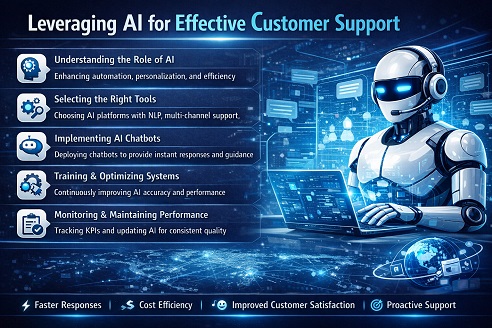
Understanding the Role of AI in Modern Customer Support Systems
Artificial intelligence has revolutionized customer support by enabling automated, intelligent, and scalable interactions. AI-powered systems can handle routine inquiries, provide instant responses, and gather valuable insights from customer interactions. This allows human agents to focus on more complex issues, improving overall efficiency and customer satisfaction. AI also facilitates 24/7 support availability, ensuring customers receive assistance whenever they need it, regardless of time zones or business hours.
Moreover, AI systems can analyze vast amounts of data to identify patterns and predict customer needs, enabling proactive support strategies. They enhance personalization by tailoring responses based on customer history and preferences. Overall, AI’s role in modern customer support is to augment human capabilities, reduce response times, and deliver consistent, high-quality service. As technology advances, AI continues to evolve, offering increasingly sophisticated solutions for managing customer relationships.
Selecting the Right AI Tools and Platforms for Your Business
Choosing the appropriate AI tools and platforms is crucial for successful integration into your customer support framework. Start by assessing your business needs, such as the volume of inquiries, types of support required, and the level of automation desired. Consider platforms that offer customizable features, easy integration with existing systems, and scalability to grow with your business. Popular AI support tools include chatbot platforms, virtual assistants, and AI-powered helpdesk solutions.
When evaluating options, look for the following features:
- Natural Language Processing (NLP) capabilities for understanding customer queries
- Multi-channel support (website, social media, messaging apps)
- Analytics and reporting tools for performance tracking
- Ease of use and deployment, including API integrations
- Support and training from the provider to ensure smooth adoption
Investing time in research and testing different platforms can help identify the best fit for your specific requirements, ensuring a seamless and effective AI support system.
Implementing AI Chatbots to Enhance Customer Interaction Experiences
AI chatbots serve as the frontline of customer support, providing instant responses to common questions and guiding users through troubleshooting processes. Deploying chatbots involves designing conversational flows that mimic natural dialogue, making interactions intuitive and engaging. It’s essential to program the chatbot with a comprehensive knowledge base and ensure it can escalate complex issues to human agents seamlessly.
To maximize effectiveness, consider the following best practices:
- Personalize interactions by using customer data to tailor responses
- Keep the chatbot’s language friendly, clear, and professional
- Regularly update the chatbot’s knowledge base with new information and FAQs
- Use analytics to monitor interactions, identifying areas for improvement
- Offer options for customers to connect with human support when needed
An AI chatbot, when properly implemented, can significantly reduce wait times, increase support availability, and improve overall customer experience by providing prompt and accurate assistance around the clock.
Training and Optimizing AI Systems for Accurate Customer Responses
Training AI systems involves feeding them with relevant data to improve their understanding and response accuracy. This process includes curating a diverse set of customer interactions and feedback to teach the AI how to interpret different queries and deliver appropriate answers. Continuous learning is vital, as language, customer preferences, and support needs evolve over time.
Optimization involves regular testing, analyzing performance metrics, and refining algorithms to enhance accuracy and relevance. Incorporate feedback loops where customer interactions are reviewed, and insights are used to update the AI’s knowledge base. Employing techniques like supervised learning and natural language understanding (NLU) tuning can further improve response quality.
Additionally, investing in ongoing training ensures your AI support system remains aligned with your business goals and customer expectations. Properly trained and optimized AI systems lead to fewer misunderstandings, higher resolution rates, and increased customer satisfaction.
Monitoring and Maintaining AI Performance for Consistent Support Quality
Continuous monitoring is essential to ensure AI systems deliver reliable and high-quality support. Use analytics dashboards to track key performance indicators such as response accuracy, resolution times, customer satisfaction scores, and escalation rates. Regularly review interactions to identify recurring issues or misunderstandings that may require system updates or retraining.
Maintenance involves updating the AI’s knowledge base with new information, fixing bugs, and refining conversational flows based on customer feedback and performance data. It’s also important to monitor for potential biases or inaccuracies in AI responses and address them proactively. Establishing a dedicated team or process for ongoing oversight ensures your AI support remains effective and aligned with your service standards.
By maintaining vigilant oversight, you can prevent issues before they impact customer experience and continuously improve your AI support system for consistent, high-quality service delivery.
Exploring Future Trends and Innovations in AI Customer Support
The future of AI in customer support is poised to bring even more sophisticated and personalized experiences. Innovations such as advanced natural language understanding, emotion detection, and contextual awareness will enable AI systems to interpret customer sentiments and respond more empathetically. Integration with voice assistants and augmented reality (AR) tools could further expand support channels, making interactions more seamless and accessible.
Emerging trends include the use of AI-driven predictive analytics to anticipate customer needs before they arise, enabling proactive engagement. Additionally, the combination of AI with human agents through hybrid support models will optimize resource allocation, delivering quick responses while maintaining a personal touch for complex issues. As AI technology advances, ethical considerations around data privacy and transparency will also shape how businesses deploy these solutions.
Staying informed about these trends allows companies to adopt innovative tools that enhance customer satisfaction, streamline operations, and maintain a competitive edge in the evolving landscape of customer support.









User's Comments
No comments there.