


Stories you may like
How AI Streamlines Tasks to Help Entrepreneurs Save Time
In today’s fast-paced business environment, entrepreneurs face the constant challenge of managing numerous tasks efficiently while striving for growth and innovation. Artificial Intelligence (AI) has emerged as a powerful ally, offering tools and solutions that help entrepreneurs save valuable time. By automating repetitive activities, providing insightful data analysis, and enhancing customer engagement, AI enables business owners to focus on what truly matters—driving their ventures forward. This article explores the multifaceted ways AI contributes to time savings for entrepreneurs, highlighting practical applications and benefits across various aspects of business management.
As AI technology continues to evolve, its integration into entrepreneurial workflows becomes increasingly accessible and impactful. From small startups to established enterprises, AI-driven tools are transforming how entrepreneurs operate, making processes smoother and more efficient. Understanding these advancements helps business leaders leverage AI effectively to optimize their time, reduce operational burdens, and improve overall productivity.
Understanding AI’s Role in Streamlining Entrepreneurial Tasks
Artificial Intelligence plays a crucial role in simplifying complex and time-consuming tasks that entrepreneurs often face. By using machine learning algorithms and natural language processing, AI can analyze large datasets, recognize patterns, and generate actionable insights much faster than traditional methods. This capability allows entrepreneurs to delegate routine analytical work to AI systems, freeing up time for strategic planning and innovation.
Moreover, AI can integrate various business functions into unified platforms, reducing the need to switch between multiple tools and applications. This seamless integration improves workflow continuity and minimizes the time wasted on administrative overhead. As a result, entrepreneurs can focus more on growth-oriented activities rather than getting bogged down by operational complexities.
Automating Routine Activities to Increase Efficiency
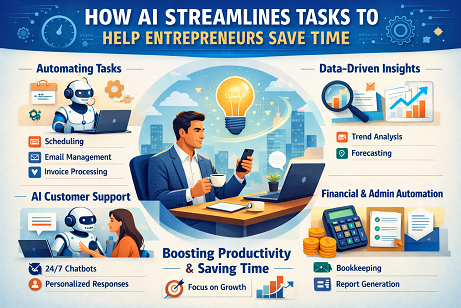
One of AI’s most significant contributions to time savings is its ability to automate repetitive and mundane tasks. Entrepreneurs often spend substantial time on scheduling meetings, managing emails, data entry, and customer follow-ups—activities that AI-powered tools can handle efficiently. Automation not only speeds up these processes but also reduces human error, ensuring consistency and accuracy.
Examples of routine activities that AI can automate include:
- Email filtering and response suggestions
- Calendar management and appointment scheduling
- Invoice generation and payment reminders
- Social media posting and monitoring
- Inventory tracking and order processing
By offloading such tasks to AI systems, entrepreneurs can concentrate on higher-value responsibilities, such as business development and relationship building, ultimately enhancing overall productivity.
Improving Decision-Making with Data-Driven Insights
AI enhances decision-making by processing vast amounts of data and providing entrepreneurs with clear, data-driven insights. These insights help identify trends, customer preferences, and market opportunities that might otherwise remain hidden. AI tools use predictive analytics to forecast outcomes, enabling entrepreneurs to make informed choices backed by evidence rather than intuition alone.
In addition, AI-powered dashboards and visualization tools simplify complex data sets, presenting information in an accessible format. This clarity accelerates decision-making processes and helps entrepreneurs quickly adapt to changing market conditions. The ability to leverage real-time data insights ensures that time spent on strategic decisions is both efficient and effective.
Enhancing Customer Interaction Through AI Tools
Customer engagement is a critical area where AI significantly saves time for entrepreneurs. AI-powered chatbots and virtual assistants can handle a large volume of customer inquiries around the clock, providing instant responses without the need for human intervention. This capability not only improves customer satisfaction but also frees entrepreneurs and their teams from constant monitoring and manual communication tasks.
Furthermore, AI tools can personalize customer interactions by analyzing behavior and preferences, delivering tailored recommendations and offers automatically. This personalized approach increases conversion rates and builds stronger customer relationships without requiring additional time investment from entrepreneurs. Ultimately, AI-driven customer service tools enable businesses to scale their support operations efficiently.
Managing Time Effectively by Prioritizing High-Impact Work
AI assists entrepreneurs in managing their time effectively by helping prioritize tasks that have the highest impact on business goals. Time management applications powered by AI can analyze workload, deadlines, and project importance to suggest optimal schedules and task sequences. This prioritization reduces procrastination and ensures that critical activities receive adequate attention.
Additionally, AI can monitor productivity patterns and provide feedback on how time is spent, highlighting areas for improvement. Entrepreneurs can use these insights to eliminate distractions and focus on activities that drive revenue and growth. By aligning daily efforts with strategic objectives, AI helps maximize the return on time invested.
Leveraging AI for Financial and Administrative Support
Financial management and administrative duties are often time-intensive for entrepreneurs, but AI offers substantial support in these areas. Automated accounting software powered by AI can reconcile transactions, generate financial reports, and even detect anomalies such as fraud risks. This automation reduces the need for manual bookkeeping and accelerates financial closing processes.
On the administrative side, AI tools can manage document processing, contract analysis, and compliance monitoring, tasks that typically require significant time and attention. By streamlining these functions, entrepreneurs can reduce overhead costs and focus on core business activities. Integrating AI into financial and administrative workflows results in more accurate, timely, and efficient operations.









User's Comments
No comments there.