


Stories you may like
AI vs Human Creativity in Business: A Comparative Analysis
In the rapidly evolving landscape of modern business, creativity remains a cornerstone of innovation, competitive advantage, and growth. However, the advent of artificial intelligence (AI) has introduced new dynamics to how creative processes unfold within organizations. AI systems, capable of processing vast amounts of data and generating novel outputs, are increasingly integrated into business functions traditionally driven by human ingenuity. This convergence raises important questions about the distinct roles of AI and human creativity, their interplay, and the implications for future business innovation.
This article explores the multifaceted relationship between AI and human creativity in business. By examining their differences, complementary strengths, and collaborative potential, we aim to provide a nuanced understanding of how these forces shape innovation in contemporary enterprises. From the foundational role of AI in creativity to practical case studies and future perspectives, we will delve into the opportunities and challenges that arise when machines and humans co-create in business contexts.
Understanding the Role of AI in Modern Business Creativity
Artificial intelligence has become a vital tool in augmenting creativity within modern businesses. Rather than replacing human creativity, AI often functions as a catalyst that accelerates idea generation and problem-solving. By leveraging machine learning algorithms, natural language processing, and data analytics, AI can identify patterns, suggest innovative solutions, and automate routine creative tasks. This allows human teams to focus more on strategic and conceptual aspects of creativity that require emotional intelligence and critical thinking.
Moreover, AI’s ability to process and analyze large datasets enables businesses to uncover insights that would be difficult or impossible for humans to detect unaided. For example, AI-driven market analysis can reveal emerging trends and consumer preferences, guiding creative campaigns and product development. In this way, AI serves as both a creative partner and a resource enhancer, reshaping how companies innovate and compete in fast-paced markets.
Key Differences Between AI and Human Creative Processes
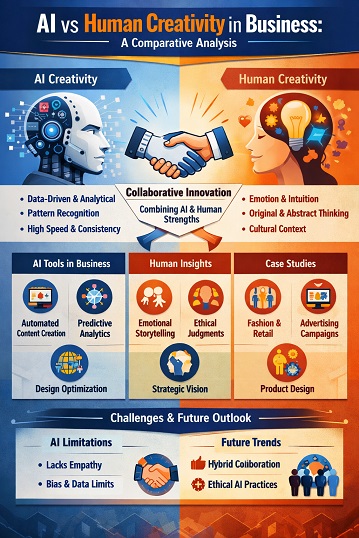
While AI and humans both contribute to creative processes, their approaches and capabilities differ significantly. Human creativity is often characterized by intuition, emotional depth, and the ability to draw on diverse experiences and cultural contexts. Humans can think abstractly, embrace ambiguity, and generate ideas that break conventional boundaries, often driven by intrinsic motivation and personal values.
In contrast, AI creativity is rooted in data-driven algorithms and pattern recognition. AI systems generate outputs based on training data and programmed objectives, excelling at combining existing information in novel ways but lacking true consciousness or emotional insight. Some key differences include:
- Emotional engagement: Humans incorporate feelings and empathy, while AI operates without emotion.
- Originality: Humans can produce truly original concepts; AI typically synthesizes or extrapolates from existing data.
- Contextual understanding: Humans interpret nuance and cultural context better than AI.
- Consistency: AI offers consistent performance without fatigue, unlike humans.
How AI Enhances Innovation and Idea Generation
AI enhances innovation by providing businesses with tools that can rapidly generate, evaluate, and optimize ideas. For instance, AI-powered brainstorming platforms can suggest creative concepts based on vast databases of prior work, enabling teams to explore a broader range of possibilities. AI can also simulate market reactions or predict the success of new products through predictive analytics, helping businesses make informed decisions early in the innovation process.
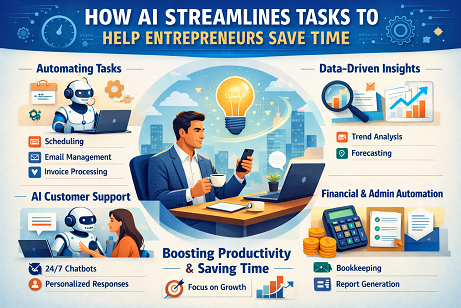
Additionally, AI-driven automation reduces the time spent on repetitive or data-intensive tasks, freeing human creatives to focus on high-level strategy and refinement. AI can also identify gaps in the market or unmet customer needs by analyzing consumer data, thus inspiring new product features or service models. Some practical applications include:
- Automated content creation (e.g., marketing copy, visuals)
- Design optimization using generative adversarial networks (GANs)
- Personalized customer experiences powered by AI insights
- Rapid prototyping and scenario simulations
Limitations of AI Compared to Human Intuition
Despite its strengths, AI has inherent limitations that restrict its creative potential. One major constraint is its lack of genuine intuition and emotional intelligence, which are crucial for understanding human motivations, ethical considerations, and complex social dynamics. AI cannot truly empathize or grasp the subtleties of human experience, which often inspire groundbreaking creative ideas.
Furthermore, AI’s reliance on existing data means it can inadvertently perpetuate biases present in training sets or fail to imagine concepts outside its programmed scope. It also struggles with ambiguity and open-ended problems that do not have clear parameters. These limitations highlight the irreplaceable role of human intuition in navigating uncertainty, contextualizing ideas, and making value-based judgments that machines cannot replicate.
Case Studies: AI and Human Collaboration in Business
Several businesses have demonstrated the power of combining AI with human creativity to achieve innovative outcomes. For example, in the fashion industry, companies like Stitch Fix use AI algorithms to analyze customer preferences and trends, which human stylists then interpret to curate personalized clothing selections. This synergy enhances customer satisfaction while driving creative styling decisions.
In advertising, firms like IBM have developed AI tools that generate initial creative concepts or optimize ad placements, but human teams refine messaging to ensure emotional resonance and brand alignment. Similarly, in product design, AI can rapidly prototype variations based on user data, with human designers selecting and adapting the best ideas to align with strategic goals. These cases illustrate how AI-human collaboration can amplify creativity rather than replace it.
Future Outlook: Balancing AI and Human Creativity
Looking ahead, the balance between AI and human creativity will likely become more integrated and dynamic. Businesses are expected to adopt hybrid models where AI handles data-driven and repetitive creative tasks, while humans focus on strategic thinking, ethical considerations, and emotional storytelling. This balance will require new skills, including AI literacy for creative professionals and greater emphasis on interdisciplinary collaboration.
Ethical and societal implications will also shape the future of AI-human creativity partnerships. Ensuring transparency, fairness, and accountability in AI-generated outputs will be essential. Ultimately, the most successful businesses will be those that harness AI to augment, rather than supplant, human creative potential, fostering innovation ecosystems where technology and human insight coexist and thrive.







User's Comments
No comments there.