


Stories you may like
Digital Design Engineer
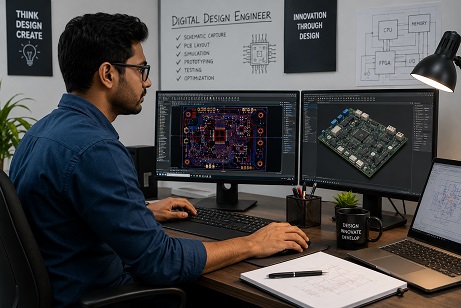
Digital design engineers create and develop digital circuits and systems, which are essential for modern technology. They use special programming languages called hardware description languages (HDLs) to design how electronic circuits work. In simple terms, they build the basic components that make computers, communication devices, and automation systems function.
Their work is behind microprocessors, embedded systems, and digital circuits found in everyday devices like smartphones, medical equipment, self-driving cars, and even aerospace technology. By improving speed, energy efficiency, and reliability, these engineers help advance artificial intelligence (AI), the Internet of Things (IoT), and high-speed computing. Without digital design engineers, many of the technologies we rely on—such as consumer electronics, industrial machines, and critical infrastructure—wouldn’t work efficiently.
Duties and Responsibilities
The job of the digital design engineer encompasses conceptualization, design, and execution of digital circuits and systems:
- Digital Circuit Design – Develop and implement digital circuits, including logic gates, state machines, and arithmetic units.
- Hardware Description Language (HDL) Coding – Write and optimize Verilog, VHDL, or SystemVerilog code for FPGA (field-programmable gateway array) and ASIC (application-specific integrated circuit) designs. An FPGA is a type of configurable integrated circuit that can be repeatedly programmable after manufacturing, while an ASIC is custom-designed for a particular task or application.
- Simulation and Verification – Use simulation tools like ModelSim, VCS, or Questa to test and validate designs before hardware implementation.
- FPGA and ASIC Development – Implement designs on FPGAs (e.g., Xilinx, Intel) or ASICs for high-performance applications.
- Synthesis and Timing Analysis – Optimize designs for power, performance, and area (PPA) while ensuring they meet timing constraints.
- Debugging and Troubleshooting – Use tools like oscilloscopes, logic analyzers, and JTAG debuggers to analyze and fix design issues.
- Collaboration with Cross-Functional Teams – Work alongside hardware, software, and system engineers to integrate digital designs into larger systems.
- Design Documentation – Maintain specifications, design reports, and test plans for project tracking and compliance.
- Power and Performance Optimization – Improve circuit efficiency to enhance battery life and reduce heat dissipation.
- Keeping Up with Industry Trends – Stay updated on emerging semiconductor technologies, AI accelerators, and high-speed digital interfaces.
Workplace of a Digital Design Engineer
Digital design engineers are in high demand across multiple industries that rely on custom digital circuits, processors, and embedded systems. These are among their most common employers:
- Semiconductor and Chip Manufacturers – Examples: Intel, AMD, NVIDIA, Qualcomm, Broadcom, Texas Instruments, Arm, MediaTek. In these environments, digital design engineers develop CPUs, GPUs, AI accelerators, and SoCs for computing, gaming, and AI applications.
- Consumer Electronics Companies – Examples: Apple, Samsung, Sony, Google, Microsoft, LG, Huawei. In these settings, engineers design custom processors, sensors, and digital circuits for smartphones, tablets, gaming consoles, and smart home devices.
- Automotive and Autonomous Vehicle Entities – Examples: Tesla, Bosch, NVIDIA, Qualcomm, Continental, Waymo. Here, digital design engineers develop ADAS (advanced driver assistance systems), self-driving hardware, and infotainment systems.
- Aerospace and Defense – Examples: Lockheed Martin, Northrop Grumman, Raytheon, BAE Systems, Thales, Boeing. In these environments, engineers work on FPGAs / ASICs for radar, avionics, communications, and secure systems.
- Telecommunications and Networking – Examples: Cisco, Ericsson, Nokia, Huawei, Juniper Networks, Broadcom. Engineers in this field design high-speed networking chips, 5G / 6G modems, and optical communication hardware.
- AI and Data Center Companies – Examples: Google (TPU), Amazon (AWS Inferentia), Meta, Microsoft (Azure), Tesla Dojo. In these settings, digital design engineers develop AI accelerators, cloud computing chips, and custom digital architectures.
- Medical and Healthcare Technology – Examples: Medtronic, GE Healthcare, Siemens Healthineers, Philips, Abbott. Engineers in this sector work on digital circuits for medical imaging, wearable health monitors, and implantable devices.
- Industrial and IoT (Internet of Things) – Examples: Texas Instruments, STMicroelectronics, NXP, Renesas, Analog Devices. In these settings, engineers design embedded systems for automation, robotics, and smart infrastructure.
- Research Institutions and Universities – Examples: MIT, Stanford, Berkeley, ETH Zurich, National Labs. Here, digital design engineers develop experimental digital systems for quantum computing, AI, and next-gen semiconductors.
- Startups and Fabless Semiconductor Companies – Examples: RISC-V startups (SiFive), AI chip startups (Graphcore, Cerebras, Groq), OpenAI, startups in quantum computing and edge AI. In these environments, engineers work on cutting-edge processors, low-power AI chips, and custom accelerators.
The workplace of a digital design engineer can vary depending on the industry and employer, but it typically involves a mix of office settings, research centers, and manufacturing environments. The workspace is usually equipped with powerful computers, simulation tools, and electronic design automation (EDA) software like Cadence, Synopsys, and Siemens EDA for designing and verifying digital circuits. In companies focused on ASIC or FPGA development, engineers may also work with testing and prototyping equipment to validate designs before production.
In addition to desk work, digital design engineers may spend time in lab environments, where they test and debug hardware components using oscilloscopes, logic analyzers, and signal generators. Collaboration is key, so engineers often participate in meetings, design reviews, and brainstorming sessions to discuss system architectures and problem-solving strategies. Some roles, particularly in semiconductor manufacturing or embedded systems development, may require on-site visits to fabrication facilities or testing labs. While many digital design engineers work in traditional office settings, remote and hybrid work options are becoming more common, especially for engineers focused on simulation, RTL design, and verification tasks.
How to become a Digital Design Engineer
Becoming a digital design engineer requires a strong foundation in electrical engineering, digital logic, and hardware description languages (HDLs). Here’s an overview of the pathway to the career:
Bachelor’s Degree
The vast majority of digital design engineers hold a bachelor’s degree in electrical engineering, computer engineering, electronics engineering technology, or computer science with a focus on hardware / software integration.
Key topics covered in these undergraduate programs include:
- Digital Logic Design
- Microprocessors and Microcontrollers
- Computer Architecture
- VLSI Design (Very-Large-Scale Integration)
- FPGA and ASIC Design
- Signal Processing
- Embedded Systems
- Programming (C, C++, Python)
Master’s Degree (Optional but Beneficial)
While a master’s degree isn’t always required, it can enhance job prospects, especially for positions in advanced design roles or research. Popular options include a master’s in electrical engineering, computer engineering, VLSI design, or embedded systems.
Advanced topics addressed in master’s programs include:
- Advanced Digital Circuit Design
- High-Speed Digital Design
- Low-Power Electronics
- FPGA / ASIC Architecture
- Semiconductor Physics
- Quantum Computing (for advanced hardware engineers)
Learn Hardware Description Languages (HDLs)
Master Verilog, VHDL, and SystemVerilog – essential for designing digital circuits. Learn SystemC for high-level modeling. Practise on FPGA boards like Xilinx Zynq and Intel DE10-Nano and simulation tools like ModelSim, QuestaSim, or Vivado.
Hands-On Experience
Work on FPGA projects, implementing state machines, ALUs, or processors. Contribute to open-source VLSI projects (e.g., OpenCores, RISC-V). Complete internships / co-ops at semiconductor companies like Intel, NVIDIA, or Qualcomm.
Become familiar with the tools that are essential for various aspects of digital design engineering:
- FPGA Development – Xilinx Vivado, Intel Quartus
- ASIC Design and Verification – Cadence, Synopsys, Siemens EDA
- Scripting – Python, Perl, Tcl for automation
Develop Problem-Solving and Debugging Skills
Learn debugging techniques using oscilloscopes, logic analyzers, and JTAG tools. Work with testbenches and simulation tools to verify designs. Join university labs or research groups working on FPGAs / VLSI. Take online FPGA / ASIC courses on platforms like Coursera, Udemy, and edX. Work on personal projects such as designing a simple CPU or an image processing unit.
Build a Strong Portfolio and Resume
Showcase projects on GitHub – include FPGA/ASIC design projects. Write about design experiences and challenges in a blog or LinkedIn articles. Highlight internships, coursework, and personal projects.
Apply for Digital Design Engineering Jobs
Look for entry-level roles like FPGA Engineer, RTL Design Engineer, or ASIC Engineer. Apply at semiconductor companies, defense contractors, AI hardware startups, and embedded systems firms. For a complete list of potential employers, please see the What is the workplace of a Digital Design Engineer like? section in the career overview.
Find jobs on company career pages (e.g., NVIDIA, AMD, Qualcomm, Apple), job portals (e.g., LinkedIn, Indeed, Glassdoor), and FPGA and hardware forums (e.g., EDAboard, Xilinx Forums).
Keep Learning and Specialize
Stay updated on emerging technologies like AI hardware accelerators, RISC-V processors, and quantum computing. Consider specializing in one of the areas described in the What does a Digital Design Engineer do? section in the career overview.
Certifications
There are several certifications that can help digital design engineers demonstrate expertise in specific tools, design methodologies, or technologies. Here are some popular ones:
FPGA Certifications
FPGA (field-programmable gate array) design is a critical skill for digital design engineers, and several certifications can validate proficiency in FPGA design.
- Xilinx FPGA Certification – Offered by Xilinx, one of the leading FPGA manufacturers, this certification covers skills related to FPGA development, design using Verilog / VHDL, and Xilinx Vivado tools.
- Intel FPGA Certification – This certification is offered by Intel (formerly Altera), which provides a range of FPGA design tools like Quartus. It recognizes proficiency in Intel FPGA development and the tools used for FPGA-based design and simulation.
ASIC and VLSI Design Certifications
For engineers interested in ASIC (application-specific integrated circuit) or VLSI (very-large-scale integration) design, certifications focusing on these fields are valuable.
- Cadence Certifications – Cadence provides several certifications for VLSI design and related tools, such as Cadence Virtuoso for analog and digital design, Allegro for PCB design, and OrCAD for schematic capture. These certifications show proficiency in industry-standard EDA (electronic design automation) tools used in ASIC and SoC design.
- Siemens EDA Certifications – These programs provide training and certification in VLSI design, analog mixed-signal design, and FPGA / ASIC verification tools. Certifications include QuestaSim (for simulation and verification) and Calibre Design Solutions (for design rule checking and layout verification).
Embedded Systems Design Certifications
These certifications are targeted at engineers working on embedded systems, which often require digital design expertise.
- Certified Embedded Systems Engineer – Offered by various technical organizations, this certification covers embedded system design, including hardware and software integration. It focuses on areas such as real-time systems, microcontroller programming, and hardware / software co-design.
- Certified LabVIEW Developer (CLD) – LabVIEW is often used for designing embedded systems and FPGA-based testing. This certification, offered by National Instruments (NI), ensures proficiency in using LabVIEW for digital hardware control and test setups.
General EDA (Electronic Design Automation) Tools Certifications
For engineers using EDA tools for simulation, layout, and verification, certifications from popular EDA software providers can be beneficial.
- Synopsys Training and Certifications – Synopsys offers training and certifications for digital designers in the use of their EDA tools like Design Compiler (for synthesis), PrimeTime (for timing analysis), and HSPICE (for analog / mixed-signal simulation).
- Siemens EDA Certifications – These are certifications for various tools that help in digital verification, signal integrity analysis, and layout generation.
General Digital Design and Electronics Certifications
These more general certifications can be useful for solidifying a broad understanding of digital circuit design.
- IPC-2221 & IPC-2222 PCB Design Certifications – These certifications are relevant for engineers involved in PCB (printed circuit board) design for digital systems, ensuring adherence to industry standards for creating reliable, manufacturable designs.
- Cisco Certified Network Associate (CCNA) – This is an entry-level information technology certification issued by networking hardware company Cisco. It is particularly relevant for engineers designing hardware for networking and communications.
- RISC-V Training and Certification – This program and credential focus on RISC-V architecture and custom digital design for open-source hardware.
Professional Organizations
In addition to the certifying bodies referenced above in the Certifications section, the following organizations also support the digital design engineering community:
- Institute of Electrical and Electronics Engineers (IEEE) – IEEE is one of the largest and most well-known professional organizations for engineers. It offers a wide range of resources, including technical papers, conferences, standards, and professional development opportunities for engineers in digital design, electronics, and computer engineering. Among the IEEE’s societies and technical areas that are relevant to digital design engineers are IEEE Circuits and Systems Society (CASS), focusing on circuits and systems design, including digital circuits and VLSI; IEEE Computer Society (CS), covering digital design, computer architecture, embedded systems, and more; and IEEE Signal Processing Society (SPS), suitable for those working on signal processing within digital systems.
- Association for Computing Machinery (ACM) – ACM is a leading organization for computer science professionals, including those in digital design, embedded systems, and hardware engineering. ACM special interest groups (SIGs) relevant to digital design engineers include SIGDA (Special Interest Group on Design Automation), focusing on EDA tools, VLSI design, and digital circuit design; SIGBED (Special Interest Group on Embedded Systems), covering embedded system design, hardware / software co-design, and real-time systems.
- VLSI Society – The VLSI Society is dedicated to very-large-scale integration (VLSI) design and computer-aided design (CAD) tools. It offers resources for engineers working in digital design, ASIC design, FPGA design, and system-on-chip (SoC) development.
- Society of Digital Engineering (SDE) – The Society of Digital Engineering offers a platform for professionals working in digital design and embedded systems. It supports activities in digital signal processing, FPGA development, digital electronics, and computer systems.
- Electronic Design Automation Consortium (EDAC) – EDAC is an organization that represents the electronic design automation (EDA) industry. It is a great resource for engineers involved in ASIC, FPGA, and PCB design, offering networking, educational opportunities, and industry standards.
- International Society for Optics and Photonics (SPIE) – SPIE focuses on optics and photonics but also includes digital design engineers involved in optical communication systems, digital signal processing for optics, and imaging technologies.
- International Association for Computer Science and Information Technology (IACSIT) – IACSIT promotes research and education in computer science, electronics, and digital system design. It hosts conferences and produces journals on embedded systems, hardware design, and software-hardware integration.
Skills Needed for a Digital Design Engineer
A Digital Design Engineer designs, develops, verifies, and tests digital electronic systems used in semiconductors, embedded systems, telecommunications, automotive electronics, consumer devices, and industrial automation.
Hard Skills
- Digital Electronics – Strong understanding of logic gates, flip-flops, counters, multiplexers, registers, and finite state machines (FSMs).
- HDL Programming – Proficiency in Hardware Description Languages such as Verilog, SystemVerilog, and VHDL.
- FPGA Design – Experience with FPGA architecture, implementation, debugging, and optimization.
- ASIC Design – Knowledge of ASIC design flow, synthesis, place-and-route, and timing closure.
- RTL Design – Ability to create efficient Register Transfer Level (RTL) designs.
- Logic Design & Optimization – Designing high-performance, low-power digital circuits.
- Digital Signal Processing (DSP) – Basic understanding of DSP concepts for digital applications.
- Circuit Simulation – Experience using simulation tools to verify circuit functionality.
- Verification & Validation – Knowledge of functional verification, testbenches, assertions, and debugging techniques.
- EDA Tools – Proficiency in tools such as Cadence, Synopsys, Xilinx Vivado, Intel Quartus, and ModelSim.
- Timing Analysis – Understanding static timing analysis (STA), setup/hold timing, and clock domain crossing (CDC).
- Scripting Languages – Familiarity with Python, Tcl, Perl, or Shell scripting for automation.
- Embedded Systems Knowledge – Understanding how digital hardware interfaces with embedded software.
- Computer Architecture – Knowledge of processors, memory systems, buses, and interfaces.
- Testing & Debugging – Ability to troubleshoot hardware issues using oscilloscopes, logic analyzers, and debugging tools.
- Version Control – Experience with Git or other version control systems.
- Documentation – Ability to prepare technical specifications, design documents, and verification reports.
Soft Skills
- Analytical Thinking – Solving complex hardware design challenges efficiently.
- Problem-Solving – Identifying and resolving design and verification issues.
- Attention to Detail – Ensuring accuracy in digital circuit design and verification.
- Critical Thinking – Evaluating multiple design approaches for optimal performance.
- Communication Skills – Explaining technical concepts clearly to multidisciplinary teams.
- Teamwork – Collaborating with verification engineers, software developers, and hardware engineers.
- Time Management – Managing multiple projects and meeting development deadlines.
- Adaptability – Learning new technologies, tools, and semiconductor design methodologies.
- Creativity – Developing innovative digital circuit solutions.
- Project Management – Planning, prioritizing, and coordinating design tasks.
- Continuous Learning – Keeping up with advancements in semiconductor technology, FPGA platforms, and EDA tools.
- Decision-Making – Making informed engineering choices based on performance, cost, and reliability considerations.
- Quality Focus – Ensuring designs meet industry standards for functionality, power efficiency, and reliability.
These technical and professional skills enable a Digital Design Engineer to develop reliable, high-performance digital systems for applications ranging from consumer electronics to advanced semiconductor technologies.
Digital Design Engineer Salary
The salary of a Digital Design Engineer depends on factors such as experience, technical expertise, industry (semiconductors, electronics, automotive, aerospace, telecommunications), and location.
India
- Entry-Level (0–2 years): ₹5 lakh–₹9 lakh per year
- Mid-Level (3–7 years): ₹9 lakh–₹18 lakh per year
- Senior-Level (8–15 years): ₹18 lakh–₹35 lakh per year
- Lead/Principal Digital Design Engineer: ₹35 lakh–₹60 lakh+ per year
International (Approximate Annual Salary)
- United States: USD 90,000–160,000
- Canada: CAD 80,000–140,000
- United Kingdom: GBP 45,000–80,000
- Australia: AUD 90,000–150,000
- Germany: EUR 60,000–100,000
- United Arab Emirates (UAE): AED 180,000–350,000
Factors That Influence Salary
- Years of experience
- Expertise in Verilog, SystemVerilog, VHDL, FPGA, ASIC, and RTL design
- Knowledge of EDA tools such as Cadence, Synopsys, Vivado, Quartus, and ModelSim
- Industry sector (semiconductor, consumer electronics, automotive, aerospace, telecommunications)
- Educational qualifications (B.E./B.Tech, M.E./M.Tech, or Ph.D. in Electronics/Electrical Engineering)
- Professional certifications and specialized training
- Company size and reputation
- Geographic location
Digital Design Engineers working for leading semiconductor and technology companies or specializing in ASIC/SoC design, FPGA development, or high-speed digital systems often earn significantly above the average salary, particularly in global technology hubs.











User's Comments
No comments there.