


Stories you may like
AI Gaming Specialist
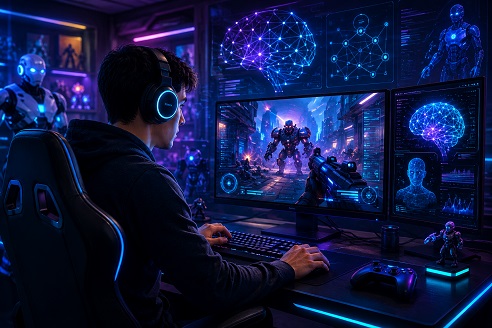
An AI gaming specialist uses artificial intelligence to create, improve, and manage AI systems in video games. They develop technologies that control non-player characters (NPCs), generate game content, personalize player experiences, and improve gameplay mechanics. Their work helps make games more engaging, realistic, and responsive to player actions.
AI gaming specialists work for video game studios, technology companies, simulation developers, and entertainment organizations. They collaborate with game designers, software developers, artists, data scientists, and quality assurance teams to build AI-powered gaming experiences. Strong skills in programming, problem-solving, game development, and AI technologies are important for success in this role.
Duties and Responsibilities
An AI gaming specialist has a variety of duties and responsibilities focused on using artificial intelligence to create engaging, realistic, and interactive gaming experiences.
- Develop Game AI Systems: Design and build AI systems that control the behavior of non-player characters (NPCs). These systems help create realistic and responsive interactions within the game world.
- Create Intelligent Gameplay Features: Develop AI-powered features that adapt to player actions and preferences. This can help make gameplay more personalized and challenging.
- Generate Game Content: Use AI tools to help create levels, quests, environments, dialogue, or other game content. This can improve efficiency and increase the variety of player experiences.
- Test and Improve AI Performance: Evaluate how AI systems perform during gameplay and identify areas for improvement. Regular testing helps ensure that AI behaviors are realistic, balanced, and enjoyable.
- Collaborate with Development Teams: Work closely with game designers, programmers, artists, writers, and quality assurance teams. Collaboration helps ensure AI systems support the overall vision and goals of the game.
- Research Emerging AI Technologies: Stay informed about new AI techniques, tools, and industry trends. Applying new technologies can help create more advanced and innovative gaming experiences.
Types of AI Gaming Specialists
AI gaming specialists can focus on different areas of game development depending on the type of AI systems they create and the gaming experiences they help build.
- Game AI Programmer: Develops AI systems that control non-player characters (NPCs) and gameplay mechanics. These specialists help create realistic and engaging in-game behavior.
- Procedural Content Generation Specialist: Uses AI to automatically create game levels, environments, quests, and other content. Their work helps increase variety and reduce development time.
- Player Experience AI Specialist: Develops AI systems that adapt gameplay based on player behavior and preferences. This helps create more personalized and enjoyable gaming experiences.
- Game Analytics Specialist: Uses AI and data analysis to study player activity and game performance. The insights gained help improve game design, balance, and player retention.
- AI Simulation Specialist: Creates AI systems used in simulations and virtual environments within games. These specialists focus on realistic interactions, behaviors, and world-building.
- Generative AI Gaming Specialist: Uses generative AI technologies to create dialogue, characters, stories, artwork, or other game assets. Their work helps expand creative possibilities in game development.
Workplace of an AI Gaming Specialist
The workplace of an AI gaming specialist is typically found in video game studios, technology companies, simulation developers, and entertainment organizations. They often work in office or remote environments where they use game engines, programming tools, AI frameworks, and development software to create intelligent and interactive gaming experiences.
AI gaming specialists work closely with game designers, software developers, artists, writers, animators, quality assurance testers, and project managers. Collaboration is an important part of the job because AI systems must work smoothly with other game features and support the overall vision of the development team.
The work is creative, technical, and focused on problem-solving. AI gaming specialists spend time developing AI behaviors, testing gameplay systems, analyzing player interactions, and improving game performance. Because gaming technology and AI continue to evolve rapidly, ongoing learning and experimentation are important parts of the role.
How to become an AI Gaming Specialist
Becoming an AI gaming specialist requires a combination of game development knowledge, programming skills, and expertise in artificial intelligence technologies used to create interactive gaming experiences.
- Earn a Relevant Degree: Start with a Bachelor's Degree in Computer Science, Game Design, Software Engineering, Artificial Intelligence, or a related field. This provides a strong foundation in programming, algorithms, and game design concepts.
- Learn Programming and Game Development: Develop skills in programming languages commonly used in gaming, such as C++, C#, and Python. Gain experience with popular game engines like Unity and Unreal Engine.
- Build AI and Machine Learning Skills: Learn how AI techniques such as machine learning, pathfinding, decision-making systems, and procedural generation are used in games. Understanding these technologies is essential for creating intelligent game systems.
- Create Game Projects: Build your own games or AI-powered gaming features to gain practical experience. Personal projects help demonstrate your technical abilities and creativity to potential employers.
- Gain Industry Experience: Look for internships, junior game development roles, or opportunities to contribute to independent game projects. Hands-on experience helps you learn how professional game development teams operate.
- Build a Portfolio and Stay Current: Create a portfolio showcasing your games, AI systems, and technical projects. Continue learning about new gaming technologies, AI tools, and industry trends to keep your skills up to date.
Skills Needed for an AI Gaming Specialist
An AI Gaming Specialist needs a combination of AI, programming, game development, data science, and creative problem-solving skills.
1. Artificial Intelligence & Machine Learning
- Understand AI concepts such as supervised and unsupervised learning.
- Build AI systems that can make decisions based on game situations.
- Train and evaluate machine-learning models.
- Understand classification, prediction, clustering, and optimization.
- Apply AI to character behavior, gameplay, and player experiences.
2. Game AI
- Design intelligent NPCs (Non-Player Characters).
- Create enemies that react realistically to players.
- Develop decision-making systems for game characters.
- Work with pathfinding and navigation.
- Build behavior trees, finite-state machines, and utility-based AI.
- Create adaptive opponents that change their behavior according to gameplay.
3. Programming
Important programming languages include:
- Python – AI, machine learning, data analysis, and automation.
- C++ – high-performance game development, especially Unreal Engine.
- C# – commonly used with Unity.
- Knowledge of programming fundamentals such as variables, functions, classes, data structures, and algorithms.
4. Unity & Unreal Engine
- Develop and integrate AI systems into games.
- Work with Unity ML-Agents and similar AI frameworks.
- Understand Unreal Engine AI systems and Behavior Trees.
- Create and test game environments.
- Debug AI behavior inside a game engine.
5. Reinforcement Learning
- Understand how an AI agent learns through rewards and penalties.
- Train game agents to play games or complete objectives.
- Understand concepts such as states, actions, rewards, policies, and environments.
- Apply reinforcement learning to NPCs, opponents, and adaptive gameplay.
6. Deep Learning & Neural Networks
- Understand neural networks and deep-learning concepts.
- Work with frameworks such as PyTorch or TensorFlow.
- Train models for game-related applications.
- Understand model evaluation and optimization.
- Apply deep learning to vision, player behavior, and generative systems.
7. Generative AI
- Understand modern generative AI technologies.
- Work with AI-generated dialogue, characters, environments, and game assets.
- Integrate large language models into games.
- Build AI-powered conversational NPCs.
- Understand prompt engineering and AI model integration.
8. Natural Language Processing (NLP)
- Create conversational game characters.
- Build systems that understand player text or voice commands.
- Integrate dialogue-generation models.
- Design realistic and context-aware NPC conversations.
9. Computer Vision
- Understand how AI processes images and video.
- Use computer vision for player interaction and game features.
- Work with object, pose, or gesture recognition where appropriate.
- Understand image-processing techniques and vision models.
10. Data Analysis
- Analyze player behavior and gameplay data.
- Use data to understand how players interact with a game.
- Identify trends and unusual behavior.
- Use tools such as SQL, Python, Pandas, and visualization libraries.
- Apply analytics to improve game design and player engagement.
11. Procedural Content Generation
- Use algorithms and AI to generate game environments and content.
- Create dynamic maps, levels, missions, items, or challenges.
- Understand procedural generation techniques.
- Combine procedural systems with generative AI.
12. Algorithms & Problem-Solving
Strong algorithmic skills are essential for:
- Pathfinding
- Decision-making
- Optimization
- Game physics interactions
- Search algorithms
- Navigation
- Resource management
Knowledge of algorithms such as A is particularly useful for game navigation.
13. Game Design Knowledge
An AI specialist should understand how games actually work:
- Game mechanics
- Player progression
- Difficulty balancing
- Level design
- Combat systems
- Game economies
- Player engagement
- Multiplayer mechanics
This helps ensure that AI improves the gameplay experience, rather than simply making the AI more technically complex.
14. AI Testing & Optimization
- Test NPC and enemy behavior.
- Find bugs in AI decision-making.
- Measure AI performance.
- Reduce unnecessary CPU/GPU usage.
- Optimize models for real-time gameplay.
- Ensure AI behaves consistently and reliably.
15. Multiplayer & Online Gaming Knowledge
For online games, useful skills include:
- Matchmaking systems
- Player behavior analysis
- Server-side AI
- Multiplayer architecture
- Anti-cheat systems
- Real-time AI performance
16. Creativity
AI Gaming Specialists need creativity to design:
- Interesting NPC personalities
- Challenging enemies
- Dynamic game events
- Unique gameplay mechanics
- Personalized player experiences
17. Communication & Teamwork
They often work with:
- Game designers
- Game programmers
- 3D artists
- Animators
- Data scientists
- Producers
- QA testers
Good communication helps translate AI ideas into practical game features.
18. Mathematics
Useful mathematical knowledge includes:
- Probability
- Statistics
- Linear algebra
- Calculus
- Optimization
- Vectors and matrices
Mathematics becomes especially important when working with machine learning, computer graphics, physics, and neural networks.
19. Software Development Tools
Familiarity with:
- Git/GitHub
- Visual Studio or VS Code
- APIs
- Databases
- Cloud platforms
- Debugging and profiling tools
- AI/ML libraries
20. Important Soft Skills
- Problem-solving
- Critical thinking
- Creativity
- Attention to detail
- Adaptability
- Teamwork
- Communication
- Continuous learning
- Time management
AI Gaming Specialist – Salary
The salary of an AI Gaming Specialist varies significantly by country, experience, technical skills, and the type of gaming company.
India:
- Entry-level (0–2 years): ₹4–8 lakh per year
- Mid-level (3–6 years): ₹8–18 lakh per year
- Senior-level (7+ years): ₹18–35+ lakh per year
- Highly experienced AI/ML specialists: ₹35–60+ lakh per year
United States:
- Entry-level: $70,000–$110,000/year
- Mid-level: $110,000–$170,000/year
- Senior-level: $170,000–$250,000+ /year
- Specialized/lead roles: $250,000–$350,000+ /year
Other countries:
- UK: £45,000–£100,000+ per year
- Canada: CAD 65,000–CAD 150,000+ per year
- Australia: AUD 75,000–AUD 170,000+ per year
- Germany: €50,000–€120,000+ per year









User's Comments
No comments there.