


Stories you may like
AI Evaluation Specialist
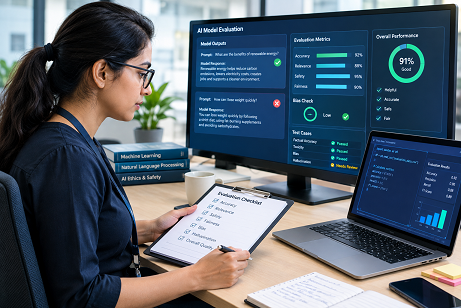
An AI evaluation specialist assesses and tests artificial intelligence systems to ensure they perform accurately, reliably, and safely. They measure how well AI models complete tasks such as answering questions, generating content, recognizing images, or making predictions. Their work helps identify errors, biases, weaknesses, and areas for improvement before AI systems are deployed or used by customers.
AI evaluation specialists work in technology companies, AI startups, research organizations, consulting firms, and industries that use artificial intelligence. They use testing methods, data analysis, and performance metrics to evaluate AI systems and compare results against established standards. Important qualities for this role include analytical thinking, attention to detail, problem-solving skills, curiosity, and a strong understanding of data, AI technologies, and quality assurance processes.
Duties and Responsibilities
An AI evaluation specialist has a variety of duties and responsibilities focused on testing, measuring, and improving the performance of artificial intelligence systems.
- AI Testing and Evaluation: Assess AI models and applications to determine how accurately and effectively they perform tasks such as answering questions, generating content, recognizing images, or making predictions.
- Performance Measurement: Use evaluation metrics, benchmarks, and testing frameworks to measure AI system performance and compare results against established goals or standards.
- Data Analysis: Review test results and analyze data to identify patterns, errors, weaknesses, and opportunities for improvement in AI models and systems.
- Quality Assurance: Verify that AI systems meet quality, reliability, and safety requirements before they are released to users or integrated into products and services.
- Bias and Risk Assessment: Evaluate AI outputs for fairness, bias, and potential risks. Help identify issues that could affect accuracy, user experience, or responsible AI practices.
- Reporting and Recommendations: Document findings, prepare evaluation reports, and provide recommendations to AI engineers, data scientists, and product teams on how to improve model performance and reliability.
Types of AI Evaluation Specialists
There are several types of AI evaluation specialists, each focusing on different AI technologies, testing methods, and areas of performance assessment.
- Generative AI Evaluation Specialist: Evaluates large language models and generative AI systems by testing the quality, accuracy, safety, and relevance of AI-generated text, images, or other content.
- Machine Learning Evaluation Specialist: Assesses machine learning models by measuring prediction accuracy, reliability, and performance across different datasets and real-world scenarios.
- AI Safety and Risk Evaluation Specialist: Focuses on identifying risks, harmful outputs, security concerns, and responsible AI issues to ensure AI systems operate safely and ethically.
- Computer Vision Evaluation Specialist: Tests AI systems that analyze images and videos, evaluating their ability to recognize objects, detect patterns, and process visual information accurately.
- Natural Language Processing (NLP) Evaluation Specialist: Evaluates AI models that understand and generate human language, measuring factors such as accuracy, context understanding, and response quality.
- Autonomous Systems Evaluation Specialist: Assesses AI systems used in robotics, drones, and autonomous vehicles by testing decision-making, navigation, perception, and overall system performance in real-world environments.
Workplace of an AI Evaluation Specialist
The workplace of an AI evaluation specialist is typically an office-based or remote environment where they spend much of their time working with computers, data, and AI systems. They use testing tools, evaluation platforms, and analytics software to assess how well artificial intelligence models perform. Many work for technology companies, AI startups, research organizations, consulting firms, and businesses that develop or use AI-powered products.
AI evaluation specialists regularly collaborate with AI engineers, data scientists, machine learning engineers, product managers, and quality assurance teams. Together, they review test results, discuss performance issues, and identify ways to improve AI systems. Strong communication skills are important because they often explain technical findings to both technical and non-technical team members.
The work is analytical and detail-oriented, with a strong focus on accuracy and problem-solving. AI evaluation specialists may spend their days creating test scenarios, reviewing AI-generated outputs, analyzing performance data, identifying biases or errors, and preparing reports. Because AI technology changes rapidly, they continuously learn about new models, evaluation methods, and industry best practices to ensure systems remain effective, reliable, and safe.
How to become an AI Evaluation Specialist
Becoming an AI evaluation specialist typically involves developing skills in data analysis, artificial intelligence, testing methodologies, and machine learning. The following steps can help prepare you for this career.
- Earn a Relevant Degree: Obtain a Bachelor's Degree in Computer Science, Data Science, Artificial Intelligence, Mathematics, Statistics, Engineering, or a related field. These programs provide the technical foundation needed to understand AI systems and data analysis.
- Learn AI and Machine Learning Fundamentals: Build knowledge of machine learning, deep learning, natural language processing, and generative AI. Understanding how AI models are developed and trained is essential for evaluating their performance.
- Develop Data Analysis and Testing Skills: Learn how to analyze data, create test cases, measure performance, and interpret evaluation results. Familiarity with quality assurance principles and performance metrics is highly valuable.
- Gain Experience with AI Evaluation Tools: Practice using AI testing frameworks, benchmarking tools, data visualization software, and model evaluation platforms. Hands-on experience helps build practical evaluation skills.
- Build a Portfolio of AI Evaluation Projects: Create projects that demonstrate your ability to test AI systems, analyze outputs, identify errors, measure performance, and provide recommendations for improvement.
- Stay Current with AI Advancements: AI technology evolves rapidly, so continuous learning is important. Follow industry trends, research developments, and emerging evaluation techniques to keep your skills up to date.
Certifications
Several professional certifications can help aspiring AI evaluation specialists develop skills in artificial intelligence, machine learning, data analysis, and responsible AI practices.
- Google Cloud Professional Machine Learning Engineer: Focuses on designing, deploying, monitoring, and evaluating machine learning models in production environments.
- AWS Certified Machine Learning Engineer – Associate: Covers machine learning workflows, model validation, performance monitoring, and continuous improvement of AI systems.
- Microsoft Certified: Azure AI Engineer Associate: Validates skills in developing, implementing, and evaluating AI solutions using Azure AI services and machine learning technologies.
- TensorFlow Developer Certificate: Demonstrates practical skills in building, training, testing, and evaluating machine learning models using one of the industry's most widely used AI frameworks.
Skills Needed for an AI Evaluation Specialist
An AI Evaluation Specialist assesses AI models and systems to determine their accuracy, reliability, safety, fairness, and overall performance. The role combines technical knowledge, analytical thinking, and strong communication skills.
Key Skills
- AI and Machine Learning Knowledge
Understanding machine learning concepts, AI models, training processes, and model evaluation methods. - Data Analysis Skills
Ability to analyze datasets, identify patterns, interpret results, and measure AI system performance. - Evaluation and Testing
Knowledge of creating evaluation criteria, benchmarks, test cases, and performance metrics for AI models. - Critical Thinking
Ability to identify incorrect, biased, misleading, or inconsistent AI-generated responses. - Prompt Engineering
Understanding how different prompts affect AI outputs and how to design prompts for systematic testing. - Programming Skills
Basic knowledge of Python, SQL, or other programming languages can help automate testing and analyze large volumes of AI outputs. - Statistical Knowledge
Understanding concepts such as accuracy, precision, recall, error rates, sampling, and statistical significance. - Natural Language Processing (NLP)
Knowledge of NLP is useful when evaluating chatbots, language models, text-generation systems, and conversational AI. - AI Safety and Ethics
Understanding issues such as bias, fairness, privacy, misinformation, harmful content, and responsible AI development. - Attention to Detail
Ability to carefully compare AI outputs against evaluation guidelines and detect subtle errors. - Problem-Solving Ability
Skill in identifying why an AI system produces poor results and helping teams improve its performance. - Communication Skills
Ability to clearly document findings, explain evaluation results, and provide useful feedback to AI developers and researchers. - Research Skills
Ability to investigate new AI techniques, evaluation frameworks, benchmarks, and industry standards. - Consistency and Objectivity
Ability to apply evaluation criteria consistently across large numbers of AI responses without personal bias. - Documentation Skills
Maintaining clear records of test results, errors, evaluation criteria, and model performance is an important part of the role.
AI Evaluation Specialist Salary
The salary of an AI Evaluation Specialist varies depending on experience, technical skills, employer, location, and the complexity of AI systems being evaluated.
Salary in India
- Entry-level: ₹3 lakh – ₹6 lakh per year
- Mid-level: ₹6 lakh – ₹12 lakh per year
- Experienced: ₹12 lakh – ₹20 lakh+ per year
- Senior AI Evaluation / AI Quality roles: ₹20 lakh – ₹30 lakh+ per year
In major technology hubs such as Bengaluru, Hyderabad, Pune, Chennai, Mumbai, and Delhi-NCR, salaries can be higher, particularly for specialists with skills in Python, machine learning, data analysis, NLP, AI safety, and automated evaluation.
International Salary
In countries such as the United States, United Kingdom, Canada, and Australia, AI evaluation professionals can earn substantially more, with compensation depending heavily on the specific job title and technical responsibilities.
Overall, professionals who combine AI/ML expertise with evaluation, testing, data analysis, and AI safety skills generally have access to higher-paying opportunities.











User's Comments
No comments there.