


Stories you may like
Vision Therapy Optometrist
A vision therapy optometrist is an eye doctor who helps people with problems related to how their eyes work together and how their brain processes what they see. Unlike regular optometrists who mostly correct blurry vision with glasses or contact lenses, vision therapy optometrists focus on functional vision issues. These are the kinds of problems that can make reading harder, affect learning, cause eye strain, or even impact sports performance and everyday comfort.
Duties and Responsibilities
The duties and responsibilities of a vision therapy optometrist involve helping patients improve the way their eyes and brain work together. Their focus goes beyond simply correcting eyesight — they address functional vision problems that affect learning, reading, sports, and daily life. Some key responsibilities include:
- Conducting Specialized Eye Exams: Perform detailed assessments to evaluate how well the eyes work together, how the brain processes visual information, and identify issues like eye teaming, tracking, or focusing problems.
- Designing Vision Therapy Programs: Create personalized therapy plans that include eye exercises, activities, and sometimes specialized equipment to strengthen visual skills and improve coordination between the eyes and brain.
- Providing Ongoing Treatment: Work closely with patients over weeks or months, guiding them through therapy sessions, adjusting programs as needed, and tracking progress toward treatment goals.
- Supporting Children and Adults: Help children who struggle with reading, attention, or learning due to vision issues, as well as adults dealing with eye strain, double vision, or vision changes after an injury.
- Collaborating with Other Professionals: Communicate and coordinate with teachers, occupational therapists, or other healthcare providers to support patients’ overall development and success.
- Educating Patients and Families: Explain vision problems in simple terms, teach strategies for daily life, and give encouragement to keep patients motivated during therapy.
Different Types of Vision Therapy Optometrists
While all vision therapy optometrists share the core focus of treating functional vision problems, some specialize in particular patient groups or conditions:
- Pediatric Vision Therapy Optometrists treat amblyopia and strabismus, address convergence insufficiency, help with eye-tracking and focusing difficulties that affect reading and learning, and work with children who have visual perceptual deficits that impact academic performance.
- Sports Vision Optometrists work with athletes to improve hand-eye coordination, reaction time, depth perception, and visual tracking to enhance performance. They address eye tracking, peripheral awareness, and dynamic visual acuity needed in fast-paced sports, and develop customized exercises to enhance visual-motor integration and overall sports performance.
- Neuro-Optometrists / Vision Rehabilitation Optometrists specialize in patients recovering from traumatic brain injuries, concussions, strokes, or neurological disorders that affect vision. They treat double vision, blurred vision, eye movement disorders, and visual field deficits caused by neurological damage, and implement vision therapy to improve visual processing, balance, and coordination during rehabilitation.
- Academic or School-Based Vision Therapy Optometrists help students with reading difficulties, dyslexia-related visual issues, or slow visual processing. They address visual attention and tracking problems that interfere with learning, and collaborate with teachers and educational specialists to support academic success.
Some vision therapy optometrists may combine these specialties, depending on their training and practice focus.
Workplace of a Vision Therapy Optometrist
Vision therapy optometrists can work in a variety of settings where patients need specialized vision care. Common employers include:
- Private Optometry Practices – clinics focused on functional vision and therapy services
- Pediatric or Family Eye Clinics – clinics that see children and adults for both general eye care and vision therapy
- Sports Vision Centers – facilities that provide performance-enhancing vision training for athletes
- Hospitals and Rehabilitation Centers – especially neuro-optometrists working with patients recovering from brain injuries, strokes, or neurological disorders
- Schools or Educational Programs – working directly with schools to support children with visual processing or learning-related vision difficulties
- Universities or Research Institutions – conducting research in vision therapy, visual development, or sports vision
In some cases, vision therapy optometrists are self-employed, offering individualized therapy programs.
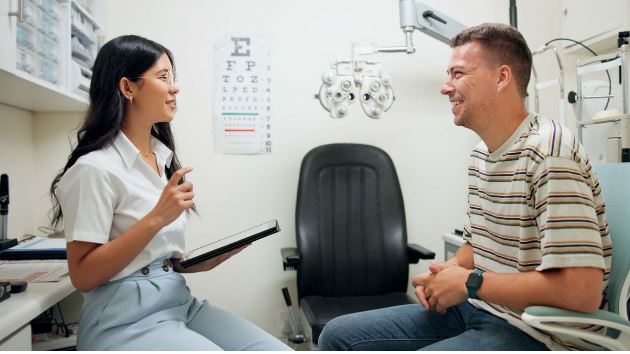
The workplace of a vision therapy optometrist is usually a special kind of clinic set up for both testing and treatment of vision problems. Unlike a regular optometry office, these clinics often have therapy rooms filled with tools like computer programs, special lenses and prisms, eye-tracking devices, and equipment for hand-eye coordination and balance exercises. The setup is designed so the optometrist can work one-on-one with patients, guiding them through activities and keeping track of their progress over time. Alongside these therapy spaces, there are also exam rooms for regular eye checkups and office areas for scheduling, record-keeping, and teaching patients and families about their care.
How to become a Vision Therapy Optometrist
Becoming a vision therapy optometrist involves completing standard optometry education and then pursuing additional training and clinical experience in vision therapy. Here’s an overview of the pathway to the career:
Earn a Bachelor’s Degree
Most students complete a bachelor’s degree in a science-related field such as biology, physiology, or health science. Prerequisite courses usually include biology, chemistry, physics, and math.
Take the Optometry Admission Test (OAT)
The Optometry Admission Test is a standardized examination designed to measure general academic ability and comprehension of scientific information. The OAT is sponsored by the Association of Schools and Colleges of Optometry (ASCO) for applicants seeking admission to an optometry program. All schools and colleges of optometry in the United States and the University of Waterloo, Canada (the only provider of English-language instruction for optometry in Canada) require the OAT.
The OAT consists of four tests: Survey of the Natural Sciences (Biology, General Chemistry, and Organic Chemistry), Reading Comprehension, Physics, and Quantitative Reasoning.
Complete a Doctor of Optometry (OD) Degree
This is a four-year professional program, required both in the United States and Canada, encompasses classroom learning in optics, ocular anatomy, diseases of the eye, pharmacology, and vision science. Clinical rotations, which provide practical, hands-on experience, may include vision therapy optometry.
To become a registered optometrist in the UK, you must complete a General Optical Council (GOC)-approved optometry degree and then undertake a 12–18-month pre-registration training scheme, which involves practical experience.
Obtain Licensure
You must pass a licensing exam to practise:
- US – Pass the three-part exam series administered by the National Board of Examiners in Optometry (NBEO). Part I: Applied Basic Science, which tests fundamental knowledge of ocular and systemic systems; Part II: Patient Assessment and Management (PAM), which evaluates clinical decision-making through case studies; and Part III: Patient Encounters and Performance Skills (PEPS), which assesses practical clinical abilities in patient interactions and skills. Canadians who wish to pursue a residency in the US must complete the NBEO exam.
- Canada – The Optometry Examining Board of Canada (OEBC) administers the registration and jurisprudence exams required to practise optometry in Canada.
- UK – Pass the Objective Structured Clinical Examination (OSCE) and then register with the general Optical Council to practise.
Complete a Residency or Fellowship in Vision Therapy and Vision Rehabilitation (Optional but Highly Recommended)
These 12-month-long post-doctoral programs are designed to provide residents/fellows with advanced experience in the assessment and management of patients of all ages with ocular motor, binocular vision, and visual perceptual anomalies.
Residents gain experience in vision therapy techniques, neuro-rehabilitation activities, and educational advocacy methods. They work with a cross-section of patients, including school children with reading challenges; adults with traumatic brain injuries; patients with visually mature conditions (diseases or disorders that typically appear after the visual system has fully developed); children with cortical/cerebral visual impairment (CVI), a visual impairment caused by damage or dysfunction in the brain rather than the eyes themselves; stroke patients; and patients who exhibit atypical responses to early-onset strabismus and amblyopia.
Pursue Certifications
Vision therapy optometrists can earn a variety of credentials to demonstrate advanced expertise beyond general optometry practice. Here’s a look at some of the most respected certifications:
- Board Certified Optometrist / ABO Diplomate – This certification, awarded by the American Board of Optometry (ABO), requires graduating from an accredited optometry school, completing a residency or qualifying points, and passing a comprehensive exam.
- ABO Certificate of Added Qualification (CAQ) – The ABO’s CAQ program allows Diplomates to earn added secondary credentials in two areas: Glaucoma and Cornea/Contact Lenses.
- Certified Optometric Vision Therapist (COVT) – This certification in vision development, vision therapy, and vision rehabilitation is offered by the Optometric Vision Development & Rehabilitation Association (OVDRA) and administered by its International Examination and Certification Board. It focuses on treating conditions like amblyopia, strabismus, and convergence insufficiency.
- Certified Myopia Management Navigator (CMN) – The CMN designation is an accreditation offered by the American Academy of Orthokeratology & Myopia Control (AAOMC) to eyecare paraprofessionals seeking to develop a basic understanding of myopia (nearsightedness) management and orthokeratology (a non-surgical eye treatment that uses specially designed rigid contact lenses worn overnight to temporarily reshape the cornea).
- Neuro-Optometric Rehabilitation Fellowship – This program was established for the membership of the Neuro-Optometric Rehabilitation Association (NORA) to develop and support the highest level of clinical abilities and scientific knowledge in the field of neuro-optometric rehabilitation (a personalized, non-invasive treatment for vision problems resulting from brain injuries, neurological conditions like stroke or Parkinson's disease, or developmental delays). It is not a certification process but rather a learning process to help the individual clinician develop deeper knowledge and understanding about neuro-optometric rehabilitation with a multi-disciplinary approach. Upon completion of all three levels of the program, participants are presented with the designation Fellow of the Neuro-Optometric Rehabilitation Association (FNORA). Individuals may also choose to attend the live Foundations of Neuro-Optometric Rehabilitation (Level 1) and Clinical Applications of Neuro-Optometric Rehabilitation (Level 2) courses without enrolling in the NORA Fellowship program. These courses are invaluable for developing the foundation knowledge of neuro-optometric rehabilitation.
Continue Professional Development
Vision therapy optometrists often pursue continuing education courses to maintain expertise and meet licensing requirements.
Professional Organizations
In addition to the certifying bodies referenced above in the Certifications section, the following organizations also support vision therapy optometrists and the broader optometric community:
- Optometric Extension Program Foundation (OEPF) – an international non-profit organization founded in 1928 dedicated to advancing optometry through continuing education, publications, and the promotion of vision therapy and behavioral optometry, a specialized area of eye care that views vision as a learned skill involving the entire visual system, including the brain and body, rather than just eyesight or visual acuity
- American Academy of Optometry – Neuro-Ophthalmic Disorders in Optometry Section – enhancing the knowledge of its members in the area of neuro-ophthalmic disease and improving the care given to patients with those diseases
- American Optometric Association (AOA) – the leading professional organization for doctors of optometry, optometry students, and paraoptometric staff
- Canadian Association of Optometrists (CAO) – supporting optometrists with clinical guidelines, continuing education, and advocacy in Canada
- International Sports Vision Association (ISVA) – an interdisciplinary group of professionals dedicated to advancing the field of vision training for athletes of all ages and levels to help them achieve peak athletic performance
- World Council of Optometry (WCO) – an international non-profit organization dedicated to promoting eye health and vision care as a human right by advancing the optometric profession globally through advocacy, education, and humanitarian outreach
Skills Needed for a Vision Therapy Optometrist
A Vision Therapy Optometrist needs a combination of clinical, technical, communication, and problem-solving skills to assess and treat visual problems that affect eye coordination, focusing, tracking, and visual processing.
1. Clinical Assessment Skills
- Ability to conduct comprehensive eye and vision examinations.
- Knowledge of binocular vision and eye coordination.
- Skill in evaluating visual acuity, focusing ability, and eye movements.
- Ability to identify vision-related problems affecting learning and daily activities.
2. Vision Therapy Techniques
- Knowledge of vision therapy exercises and treatment methods.
- Ability to design individualized therapy programs.
- Skill in using lenses, prisms, filters, and specialized therapy equipment.
- Ability to monitor and adjust treatment according to patient progress.
3. Binocular Vision Knowledge
- Strong understanding of how both eyes work together.
- Knowledge of conditions such as convergence insufficiency, accommodative disorders, and strabismus-related visual problems.
- Ability to assess depth perception, eye teaming, and visual tracking.
4. Problem-Solving Skills
- Ability to determine the underlying causes of visual difficulties.
- Analytical thinking when interpreting examination results.
- Ability to modify therapy when a patient is not responding as expected.
5. Communication Skills
- Ability to explain diagnoses and therapy procedures in simple language.
- Good listening skills to understand patients' concerns.
- Ability to communicate effectively with parents, teachers, physicians, and other healthcare professionals.
6. Patience and Empathy
- Vision therapy can require multiple sessions, so patience is essential.
- Ability to motivate patients, particularly children, to participate consistently.
- Empathy and a calm approach can help patients feel comfortable during therapy.
7. Pediatric Skills
- Ability to work effectively with children and adolescents.
- Knowledge of age-appropriate visual assessments and therapy activities.
- Creativity in making therapy exercises engaging and interactive.
8. Technology Skills
- Familiarity with computerized vision therapy systems and diagnostic equipment.
- Ability to use electronic patient records and clinical software.
- Willingness to learn emerging technologies used in optometry and vision rehabilitation.
9. Attention to Detail
- Careful observation of eye movements and visual responses.
- Accurate recording of examination and therapy results.
- Ability to identify subtle changes in visual performance.
10. Professional and Ethical Skills
- Maintaining patient confidentiality and accurate clinical records.
- Following professional optometric standards and appropriate referral practices.
- Continuing education to keep up with developments in vision therapy and eye care.
Salary of a Vision Therapy Optometrist
The salary of a Vision Therapy Optometrist varies depending on qualifications, experience, location, workplace, and specialization.
India
- Entry-level: ₹2.5–4.5 lakh per year
- Mid-level (3–7 years): ₹4.5–8 lakh per year
- Experienced: ₹8–12+ lakh per year
- Specialized/private practice: ₹10–15+ lakh per year in some cases
United States
- Optometrists generally earn around $120,000–$160,000+ per year, although earnings vary substantially by location, experience, practice setting, and specialization.
Vision therapy specialists working in established eye-care centers or running their own practices may earn more, while entry-level positions typically offer lower salaries.











User's Comments
No comments there.