


Stories you may like
AI in Research
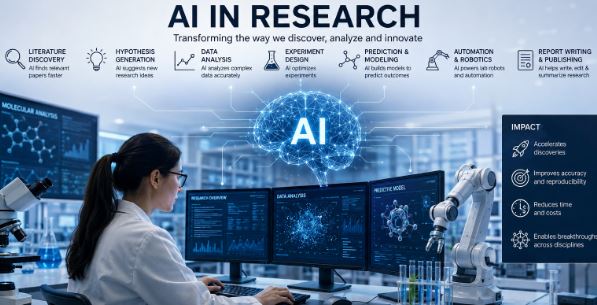
Scientific research is facing increasing pressures: massive datasets, tight deadlines, complex challenges, and the need for faster breakthroughs. Artificial intelligence (AI) is becoming an indispensable ally for researchers across the globe, helping them accelerate discoveries, streamline workflows, and make data-driven decisions.
The Growing Role of AI in Transforming Research
AI is transforming research from a traditional, manual, and time-consuming process into a streamlined, data-driven, and highly efficient industry. In the past, research was often slow, relying on trial-and-error methods and static processes. Today, AI is replacing these methods with intelligent systems that continuously adapt to real-time data, enabling researchers to make faster, more accurate decisions, reduce variability, and optimize experimental outcomes.
From drug discovery and climate modeling to academic research and medical diagnostics, AI is accelerating progress across many fields. AI-powered tools can rapidly analyze vast amounts of data, identify hidden patterns, and generate new hypotheses, enabling researchers to move forward faster. Machine learning models also help researchers better predict outcomes, reducing uncertainty and increasing the reliability of results.
Key Statistics and Trends in AI Adoption in Research
AI adoption in research is accelerating as institutions and organizations seek more efficient, accurate, and scalable solutions to drive innovation. According to MarketsandMarkets, the global AI in research market was valued at $3.5 billion in 2020 and is projected to reach $12.3 billion by 2027, growing at a CAGR of 19.4%. This growth is driven by the increasing demand for faster discoveries, more precise data analysis, and enhanced research capabilities across various disciplines.
Furthermore, machine learning and deep learning account for approximately 50% of AI technologies used in research, underscoring the shift toward intelligent data processing, automated analysis, and improved decision-making. These technologies are pivotal for tasks like analyzing complex datasets, predicting research outcomes, and optimizing experimental processes.
With growing investments in digital infrastructure, especially in North America, Europe, and Asia-Pacific, AI is increasingly becoming a core tool for research institutions looking to stay competitive and innovative. Cloud-based solutions, edge computing, and AI-powered research platforms are making it easier for institutions to scale their AI adoption, even in remote or data-intensive environments.
Business Benefits of AI in Research
AI is solving foundational challenges in research, ranging from data overload and time-consuming analyses to resource inefficiencies and limited scalability. Below are five key areas where AI is delivering measurable, transformative value in the world of research:
1. Faster and More Accurate Data Analysis
In research, particularly in fields like healthcare, climate science, and physics, vast amounts of data are generated every day. Traditional methods of data analysis can be slow, error-prone, and resource-intensive. AI is helping researchers overcome these hurdles by automating data analysis and enabling faster, more accurate results.
Machine learning models and deep learning algorithms can process and analyze large datasets with precision, detecting patterns that might be invisible to human researchers. These insights allow scientists to draw conclusions faster and more reliably, accelerating the pace of discovery. Whether analyzing clinical trial data, environmental models, or astronomical observations, AI reduces the time and effort needed to extract meaningful insights from complex datasets.
2. Enhancing Predictive Modeling and Simulations
Predictive modeling is essential in research fields like climate science, epidemiology, and drug discovery, where researchers need to anticipate future events or outcomes based on historical data. Traditional methods can struggle with the complexity and volume of data involved, often leading to inaccurate predictions or slow results.
AI is revolutionizing predictive modeling by applying machine learning algorithms that can handle vast datasets and complex variables. In drug discovery, for example, AI models can predict how certain compounds will interact with biological systems, vastly speeding up the discovery of new drugs. In climate research, AI-powered models can predict long-term environmental changes, helping policymakers make informed decisions about sustainability and conservation efforts.
3. Streamlining Literature Reviews and Knowledge Extraction
Literature reviews are a critical part of research, yet they are often time-consuming and exhaustive. Researchers have to manually read and analyze thousands of academic papers, making the process slow and inefficient. AI is solving this problem by automating the extraction of relevant information from academic literature.
NLP algorithms can scan large volumes of research papers, extracting key findings, identifying trends, and summarizing essential insights. This capability allows researchers to stay up-to-date on the latest studies without spending countless hours sifting through papers. By enabling faster access to critical knowledge, AI enhances researchers’ ability to build on existing work, identify gaps in knowledge, and generate new hypotheses.
4. Optimizing Experimental Design and Resource Allocation
Experimentation is a cornerstone of scientific research, but designing effective experiments can be a lengthy and costly process. AI helps by optimizing experimental designs through predictive models that analyze past research data to identify the most promising variables to test.
For example, in material science, AI can predict which combinations of materials will produce the desired properties, reducing the number of experiments needed. In clinical research, AI can optimize trial designs by predicting patient responses based on genetic data, minimizing the need for large, costly trials. With AI models recommending the most efficient and impactful experimental setups, researchers can allocate their resources more effectively, saving time, money, and effort.
5. Advancing Drug Discovery and Healthcare Research
AI is having a profound impact on healthcare research, particularly in drug discovery and medical diagnostics. Traditional drug discovery is a slow and costly process, with a high failure promising drug candidates faster and with more precision.
AI algorithms can analyze vast chemical libraries, genetic data, and clinical trial results to predict how different compounds will affect human biology. By identifying molecular patterns and potential interactions early in the process, AI significantly accelerates the identification of viable drug candidates.
Challenges Facing AI Adoption in Research
Despite its growing impact, AI adoption in research comes with significant challenges that can hinder its full integration and limit its effectiveness. Below are five of the most pressing obstacles that researchers and institutions face when implementing AI in their workflows:
1. Data Quality, Availability and Integration
AI systems rely heavily on high-quality, structured, and consistent data. However, in many research fields, especially in healthcare and environmental sciences, data can be fragmented, incomplete, or inconsistent. Research data is often stored in diverse formats across multiple platforms, making it difficult to integrate and analyze efficiently.
To overcome this, researchers must invest in building robust data infrastructure and implement standardized data collection practices. Without proper integration across systems and disciplines, AI models can provide incomplete, misleading, or inaccurate insights, slowing down the potential for breakthroughs.
2. Lack of AI Expertise in Research Domains
While AI holds great promise for research, its integration requires specialized knowledge in both the domain of study and AI itself. Many researchers are experts in their respective fields, but may lack the technical skills required to implement AI tools effectively. This creates a gap between researchers’ expertise and the technical knowledge needed to deploy AI systems.
As a result, AI adoption often requires collaboration between domain experts and data scientists or AI specialists. This interdisciplinary approach can be challenging due to the need for effective communication between researchers with different technical backgrounds. Additionally, the rapid pace of AI development means that ongoing training and upskilling are necessary for research teams to stay current with evolving tools and technologies.
3. High Implementation Costs
While AI has the potential to significantly improve research outcomes, the initial investment required for AI tools can be substantial. Developing and deploying AI models often requires access to high-performance computing infrastructure, specialized software, and skilled personnel—all of which can be expensive.
For many research institutions, especially those with limited budgets, the costs associated with adopting AI can be prohibitive. Smaller organizations may struggle to compete with larger institutions or private companies that have more resources to invest in AI infrastructure and talent. Furthermore, there are additional costs related to data collection, cleaning, and integration, as well as ongoing maintenance of AI systems.
4. Ethical Concerns and Data Privacy
AI in research, particularly in healthcare and social sciences, raises significant ethical concerns. These include issues related to data privacy, informed consent, and potential biases in AI algorithms. Furthermore, AI models can inadvertently reinforce existing biases present in the data they are trained on.
Addressing these challenges requires strong governance frameworks, transparent AI model development processes, and ethical guidelines to ensure that AI is used responsibly and fairly in research. Research institutions must prioritize data security, minimize bias, and ensure that ethical standards are adhered to throughout the AI development lifecycle.
5. Resistance to Change and Institutional Inertia
Adopting AI in research requires a shift in mindset and a willingness to embrace change. However, many research institutions are rooted in traditional methods and have established workflows that can be difficult to disrupt. Resistance to AI adoption may come from researchers who are skeptical of AI’s effectiveness or fear that AI could replace human judgment and expertise.
Moreover, institutional inertia can slow the pace of AI implementation, as many academic and research organizations are structured in ways that prioritize conservative approaches to innovation. The time and effort required to integrate AI into established research processes can be seen as a barrier, especially when researchers are already under pressure to meet publication deadlines and funding requirements.
Specific Applications of AI in Research
1. AI in Data Analysis and Pattern Recognition
AI-driven data analysis is revolutionizing research by allowing scientists to process massive datasets quickly and accurately. Machine learning algorithms can uncover hidden patterns, correlations, and anomalies that human researchers might miss, especially in complex or unstructured data. This application is crucial in fields like genomics, where it can identify genetic variations linked to diseases, or in social science, where it helps researchers detect emerging social trends from vast datasets.
Furthermore, AI models allow for continuous refinement of research methods as new data is incorporated. By feeding new data into existing models, researchers can improve predictions and adapt to changing conditions in real-time. This iterative approach helps to optimize the accuracy of predictions, making AI indispensable in long-term studies like climate change or drug development.
Real-World Example: In the field of genomics, DeepMind’s AlphaFold uses AI to predict protein folding, a critical area of biomedical research. By analyzing vast protein structure data, AlphaFold has successfully predicted the 3D structures of proteins, accelerating drug discovery and helping scientists understand complex diseases more effectively. This breakthrough has opened up new avenues for designing treatments and understanding the underlying causes of various medical conditions.
2. AI in Drug Discovery and Healthcare Research
AI has dramatically accelerated the pace of drug discovery by analyzing vast chemical and biological datasets to identify potential drug candidates. Using machine learning, AI models can predict the interaction between compounds and biological systems, helping researchers identify promising drugs faster than traditional methods. This reduces the time and cost of the lengthy drug development process, which can take years and requires millions of dollars.
Moreover, AI-driven tools allow for the identification of biomarkers and personalized treatment plans. By analyzing patient data, AI can predict which treatment options are most likely to work for an individual based on their unique genetic profile. This personalized approach enhances the effectiveness of treatments and minimizes the risk of side effects, bringing precision medicine to the forefront of healthcare.
Real-World Example: Insilico Medicine uses AI to identify new drug candidates and optimize clinical trial designs. Their AI-driven platform has already been used to discover a novel compound for fibrosis, which has entered clinical trials. The platform analyzes vast chemical and biological data, significantly reducing the time to identify new therapeutic opportunities.
3. AI in Environmental Science and Climate Change Research
AI is transforming environmental science by helping researchers model and predict climate patterns more accurately. Machine learning algorithms can process vast amounts of environmental data, such as temperature changes, atmospheric conditions, and carbon emissions, to identify trends and forecast future conditions. These predictions are crucial for understanding and mitigating the impacts of climate change, particularly in areas such as sea-level rise, deforestation, and biodiversity loss.
Additionally, AI-driven optimization techniques can help in resource management, improving the efficiency of renewable energy production and conservation efforts. By predicting energy demand and optimizing the use of renewable sources like wind or solar power, AI helps reduce carbon footprints and promotes sustainable practices. This technology also aids in monitoring deforestation or pollution levels, providing real-time insights that can inform policy and conservation strategies.
Real-World Example: Google’s AI for Earth initiative uses machine learning to predict and mitigate the impact of climate change. One of their projects involves using AI to analyze satellite imagery and track deforestation in real time, allowing for faster intervention and policy changes. By combining AI with environmental monitoring, Google is helping drive more effective climate action.
4. AI in Social Sciences and Behavioral Research
In the social sciences, AI is used to analyze large-scale human behavior data, providing insights into patterns and societal trends. Natural language processing (NLP) models, for example, can analyze social media posts, surveys, and online discussions to gauge public opinion on various issues. This allows researchers to better understand human behavior, political sentiment, and societal changes over time, offering real-time data for studies on social movements or political dynamics.
Additionally, AI models can identify biases in social research, helping to create more balanced and representative studies. By analyzing demographic data, AI can reveal hidden biases in surveys or datasets, ensuring that research findings are more accurate and reflective of diverse populations. This ensures that research outcomes are not skewed by unacknowledged biases, especially in sensitive areas like public health or criminology.
Real-World Example: The Behavioral Insights Team (BIT) uses AI to analyze data from various sources, including social media and surveys, to better understand human behavior. Their AI-powered tools help governments and organizations design policies that promote positive behavioral changes, such as encouraging healthy eating or boosting vaccination rates. This data-driven approach has led to more effective public policy interventions worldwide.
5. AI in Automation and Experimentation
AI-driven automation is accelerating research by reducing the time spent on repetitive tasks such as data collection and analysis. In experimental research, AI can automate laboratory processes like sample testing, data logging, and analysis, freeing up researchers to focus on more complex aspects of their work. This automation not only increases the speed of experiments but also reduces the likelihood of human error, ensuring more consistent and reliable results.
Additionally, AI is used to optimize experimental design by predicting which conditions are most likely to yield successful results. By analyzing historical data from previous experiments, AI models can suggest optimal testing parameters or new experimental approaches. This helps researchers prioritize their time and resources more effectively, improving overall research efficiency and outcomes.
Real-World Example: Labster, a company that offers virtual labs powered by AI, provides students and researchers with automated experiments that simulate real-world laboratory settings. Their AI-driven platform helps users conduct experiments remotely, saving time and resources while offering instant feedback and results. This innovation is transforming how both educational and professional researchers approach experimentation.
6. AI in Scientific Collaboration and Knowledge Discovery
AI is enhancing scientific collaboration by facilitating the sharing and synthesis of research findings across disciplines. Knowledge graphs and AI-driven recommendation systems can suggest relevant papers, researchers, or datasets to help connect researchers from different fields. This ability to discover new connections and insights fosters cross-disciplinary collaboration, which is increasingly important for tackling complex, global challenges like pandemics or climate change.
Furthermore, AI models can help identify gaps in existing research, guiding scientists toward unexplored areas or emerging topics. By analyzing the body of existing research, AI can pinpoint under-researched topics and suggest novel research directions. This encourages more efficient and innovative scientific discovery by highlighting areas that require further exploration.
How to Implement AI in Research
Step 1: Assessing Readiness for AI Adoption
Before introducing AI into research workflows, it’s essential to pinpoint areas where AI can deliver measurable improvements. Begin by identifying phases of the research cycle that are data-intensive, repetitive, or involve time-consuming analysis. These often include literature reviews, data annotation, statistical modeling, and experiment optimization, domains where AI can significantly accelerate outcomes or uncover patterns hidden in complex datasets.
Readiness assessment also requires a comprehensive look at infrastructure, culture, and collaboration. Evaluate whether your current systems can support AI tools from data formats and storage architecture to compute resources and internet connectivity. Equally important is assessing team readiness: are researchers open to integrating AI into their workflow, or is there skepticism? Including scientists, data engineers, and institutional IT leaders early in the process ensures buy-in and sets the groundwork for long-term success.
Step 2: Building a Strong Data Foundation
AI models are only as reliable as the data they’re built on. For research institutions, this begins with collecting, cleaning, and organizing data from diverse sources, be it lab sensors, observational logs, survey results, or legacy databases. Data should be structured, labeled, and timestamped in formats that AI systems can interpret easily and consistently.
Establishing strong data governance is equally crucial. This includes setting standards for data quality, access permissions, version control, and compliance, especially in sensitive research areas like genomics, social science, or healthcare. Whether training an AI model to predict molecular behavior or automate document classification, a well-managed data ecosystem ensures your insights are not just accurate but replicable and ethically sound.
Step 3: Choosing the Right Tools and Vendors
Finding the right AI tools for research means balancing flexibility, transparency, and domain alignment. Many open-source platforms provide robust support for customizing models to fit specific research goals, such as NLP for academic literature mining or computer vision for imaging datasets. Choose tools that allow for rapid prototyping, reproducibility, and easy integration with existing workflows like Jupyter Notebooks or institutional data lakes.
When evaluating vendors, look for those with a track record in scientific applications—not just general-purpose AI. Ask how their tools support collaboration, data privacy, and continuous learning. Some research units may benefit from modular AI solutions, while others might require full-stack development partnerships. A clear understanding of licensing costs, hardware compatibility, and support requirements helps prevent costly misalignments or underutilized technologies.
Step 4: Pilot Testing and Scaling Up
Piloting is the safest way to validate AI’s impact without disrupting the broader research process. Start with one or two high-value use cases, such as automating figure labeling in published papers or using AI to suggest citations. Choose areas where results can be easily quantified, like time saved, accuracy improvements, or expanded analytical capacity.
Once a pilot demonstrates tangible value, scaling becomes a structured process of integration and replication. Expand across departments by tailoring models to new datasets, disciplines, or experimental conditions. Document learnings from early rollouts to inform protocols and reduce friction in future deployments. As research projects evolve, your AI systems should be designed to adapt and iterate with them.
Step 5: Training Teams for Successful Implementation
People determine whether AI adoption thrives. Training your teams ensures AI becomes a trusted part of the research process rather than an opaque tool. Focus on practical education: teach researchers how to evaluate model outputs, manage data pipelines, and integrate AI into their existing analysis routines. Avoid overly technical training unless it’s tied directly to research needs.
Interdisciplinary collaboration is vital. Encourage dialogue between domain experts and technical staff to co-design AI applications that reflect real-world constraints and goals. Peer-led workshops, collaborative pilot reviews, and shared repositories can help foster a culture of learning. Empowering teams through continuous training not only boosts AI adoption—it also turns researchers into champions of innovation.











User's Comments
No comments there.