


Stories you may like
New AI Method Tackles One of Science’s Hardest Math Problems
Researchers at the University of Pennsylvania have introduced a groundbreaking artificial intelligence method to solve one of mathematics’ most difficult challenges: inverse partial differential equations (inverse PDEs). These equations are critical for understanding complex scientific systems, but solving them has traditionally stretched the limits of mathematics and computing.
The research team developed a new approach called “Mollifier Layers,” which improves how AI solves inverse PDEs by refining the mathematical process itself rather than relying solely on greater computing power. The innovation could lead to major advances in fields such as genetics, materials science, and weather forecasting.
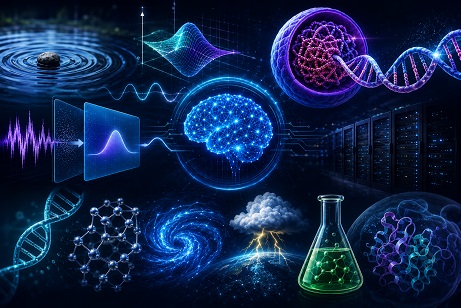
“Solving an inverse problem is like looking at ripples in a pond and working backward to figure out where the pebble fell,” explains Vivek Shenoy, senior author of the study. “You can clearly observe the effects, but the real challenge is uncovering the hidden cause.”
The findings were published in the journal Transactions on Machine Learning Research (TMLR) and will also be presented at the Conference on Neural Information Processing Systems 2026.
Why Inverse PDEs Are Important
Differential equations are essential tools in science because they describe how systems change over time. They are used to model phenomena such as:
- Population growth
- Heat transfer
- Chemical reactions
- Weather systems
- Fluid motion
Partial differential equations (PDEs) extend this idea further by describing how systems evolve across both space and time.
Inverse PDEs are even more challenging because they work backward: instead of predicting outcomes from known rules, scientists begin with observed data and try to infer the hidden mechanisms causing those observations.
For years, researchers used these equations to study chromatin, the folded structure of DNA inside the cell nucleus. While scientists could observe chromatin structures and simulate their behavior, identifying the underlying epigenetic processes remained extremely difficult.
“The more we optimized existing approaches, the clearer it became that the mathematics itself needed to change,” says Shenoy.
The Problem With Traditional AI Methods
Modern AI systems often calculate changes using a process called recursive automatic differentiation. This technique repeatedly computes derivatives as data moves through a neural network.
While effective in simpler systems, the method struggles with:
- Noisy data
- Complex scientific systems
- High computational demands
- Numerical instability
Researchers compared it to repeatedly zooming in on a jagged line: each step amplifies imperfections, making the final result less reliable.
How Mollifier Layers Work
The breakthrough came from a mathematical concept introduced in the 1940s by mathematician Kurt Otto Friedrichs called mollifiers. Mollifiers are mathematical tools designed to smooth irregular or noisy functions.
The Penn researchers adapted this concept into AI by creating a mollifier layer inside neural networks. This layer smooths the input data before differentiation occurs, reducing instability and improving accuracy.
“We initially thought the issue was the neural network architecture,” says Ananyae Kumar Bhartari. “Eventually, we realized the bottleneck was recursive automatic differentiation itself.”
The result was a dramatic reduction in both computational cost and noise, allowing inverse PDEs to be solved more efficiently and reliably.
Potential Impact on Genetics and Medicine
One of the most exciting applications involves understanding chromatin organization inside cells.
Chromatin structures are incredibly small—around 100 nanometers in size—but they strongly influence:
- Gene expression
- Cell identity
- Aging
- Disease progression
By estimating epigenetic reaction rates more accurately, the new AI framework could help researchers predict how chromatin changes during aging, cancer development, and cellular growth.
“If we can track how these reaction rates evolve,” says Vinayak Vinayak, “it opens the possibility for therapies that redirect cells toward desired states.”
Broader Scientific Applications
The potential uses of mollifier layers extend well beyond biology. The method could improve AI-driven modeling in areas such as:
- Materials science
- Fluid dynamics
- Climate and weather prediction
- Engineering simulations
- Chemical system analysis
Because many scientific fields rely on solving noisy and highly complex equations, the framework may provide a more stable and energy-efficient computational approach.
A Step Toward Deeper Scientific Understanding
The researchers believe their work represents more than just a technical improvement in AI.
“Ultimately, the goal is to move from observing complex patterns to quantitatively uncovering the rules that generate them,” says Shenoy. “Once you understand those rules, you gain the possibility of changing the system itself.”
This breakthrough highlights how advances in mathematics—not just larger computers—can push artificial intelligence into new scientific frontiers.











User's Comments
No comments there.