


Stories you may like
Multimodal AI engineer
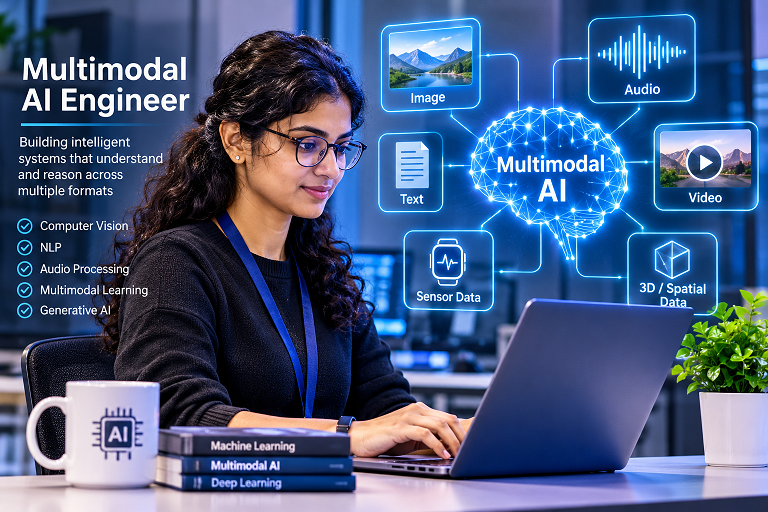
A multimodal AI engineer builds artificial intelligence systems that can understand and work with more than one type of data at the same time. Instead of only processing text like chatbots or only images like basic computer vision models, multimodal AI combines different inputs such as text, images, audio, video, and sometimes sensor data. For example, a multimodal system could look at a photo, read a question about it, and then generate a useful answer. These engineers design and train models that connect different types of information so the system can understand context in a more human-like way.
Work in this field is found in tech companies, AI research labs, autonomous vehicle companies, robotics firms, healthcare technology, and startups building AI products. Common roles involve improving AI assistants, developing perception systems for robots and self-driving cars, and building tools that analyze images, video, and language together. Important qualities include strong problem-solving skills, curiosity about how intelligent systems work, and comfort with mathematics, coding (especially Python), and machine learning tools like PyTorch or TensorFlow. Attention to detail and the ability to work with large, complex datasets are also important for success in this career.
What does a Multimodal AI Engineer do?
Duties and Responsibilities
A multimodal AI engineer has a range of duties and responsibilities focused on designing, building, and improving AI systems that can process and combine different types of data such as text, images, audio, video, and sensor inputs.
- Multimodal AI System Development: Design and develop AI models that integrate multiple data types to solve real-world problems such as image understanding, video analysis, speech recognition, and AI assistants. Select appropriate model architectures such as transformer-based models and multimodal neural networks to ensure accurate and efficient performance.
- Data Processing and Integration: Collect, clean, and prepare large datasets that include mixed formats like text, images, audio, and video. Ensure different data sources are properly aligned and structured so the AI system can learn relationships across modalities.
- Model Training and Optimization: Train multimodal AI models using machine learning frameworks such as PyTorch or TensorFlow. Fine-tune models for accuracy, speed, and scalability, and experiment with techniques to improve how well different data types are combined and interpreted.
- System Deployment and Integration: Deploy AI models into production environments such as cloud platforms, mobile applications, robotics systems, or autonomous vehicles. Work with software engineers to integrate AI capabilities into real-world products and services.
- Performance Evaluation and Improvement: Test and evaluate model performance using metrics relevant to tasks like classification, detection, or generation. Continuously refine models to improve accuracy, reduce bias, and enhance reliability across different types of inputs.
Types of Multimodal AI Engineers
Multimodal AI engineers can specialize in different areas depending on the type of data they work with and the systems they help build. Here are some real and commonly recognized types of roles within this field:
- Vision-Language AI Engineer: Focuses on systems that connect images or video with text, such as image captioning, visual question answering, and AI assistants that can “see” and describe content. This role is common in companies building search engines, accessibility tools, and generative AI products.
- Speech and Audio AI Engineer: Works on systems that combine spoken language with other data types, such as speech-to-text, voice assistants, and audio understanding models. This includes building AI that can understand tone, emotion, and spoken context alongside text or visuals.
- Autonomous Systems AI Engineer: Develops AI for robots, drones, and self-driving cars by combining camera data, lidar, radar, and sometimes text-based instructions. This role focuses heavily on real-time decision-making and safety-critical AI systems.
- Robotics Perception Engineer: Specializes in helping robots understand their environment using multiple sensors such as cameras, depth sensors, and inertial measurement units. This work is often used in industrial automation, warehouse robotics, and service robots.
- AI Research Engineer (Multimodal Models): Works on designing and improving new multimodal architectures, such as large foundation models that can process and generate multiple data types. This role is common in AI labs and major tech companies focused on cutting-edge model development.
- AI Product Engineer (Multimodal Applications): Focuses on turning multimodal AI models into usable products, such as AI assistants, creative tools, or enterprise applications. This includes integrating models into apps, optimizing performance, and improving user experience.
What is the workplace of a Multimodal AI Engineer like?
A multimodal AI engineer usually works in modern office environments at tech companies, research labs, or startups, but a lot of the work can also be done remotely. The workplace is typically computer-focused, with powerful laptops or workstations, cloud computing tools, and access to large datasets. Many engineers spend most of their day writing code, training AI models, and testing how well those models handle different types of data like images, text, and audio.
The environment is often collaborative. Multimodal AI engineers work closely with other engineers, data scientists, product managers, and designers to figure out what the AI system needs to do and how it should behave in real products. Meetings are common for planning features, reviewing model performance, and solving technical problems together. In larger companies, there may also be dedicated AI research teams and infrastructure teams that support the work.
Day-to-day work is a mix of focused independent problem-solving and team-based development. Engineers might experiment with new AI model designs in the morning, debug training issues in the afternoon, and review results or deploy updates later in the day. Even though the work is highly technical, it is also very practical, since the goal is usually to build AI systems that can be used in real-world products like assistants, robots, or smart devices.
How to become a Multimodal AI Engineer
Becoming a multimodal AI engineer requires a combination of education, technical skills, and hands-on experience working with AI systems that process multiple types of data.
- Earn a Relevant Degree: Most multimodal AI engineers start with a Bachelor's Degree in Computer Science, Software Engineering, Artificial Intelligence, Data Science, Mathematics, or a related field. Some advanced research roles may require a master's degree or PhD.
- Learn Programming and Software Development: Develop strong programming skills, especially in Python, which is widely used for AI and machine learning. Learning software engineering fundamentals, algorithms, data structures, and version control tools like Git is also important.
- Study Machine Learning and Deep Learning: Build a solid understanding of machine learning concepts, neural networks, deep learning, computer vision, natural language processing, and speech recognition. Frameworks such as PyTorch and TensorFlow are commonly used in the field.
- Gain Experience with Multimodal AI Systems: Learn how to work with different types of data, including text, images, audio, video, and sensor information. Practice building projects that combine multiple data sources, such as image-captioning systems, visual question-answering tools, or multimodal AI assistants.
- Build a Portfolio of AI Projects: Create and showcase projects that demonstrate your ability to design, train, and deploy AI models. A strong portfolio can include GitHub repositories, research projects, personal applications, or contributions to open-source AI initiatives.
- Stay Current with Emerging Technologies: Multimodal AI is a rapidly evolving field. Follow industry developments, experiment with new models and tools, pursue relevant certifications, and continue learning through courses, research papers, and hands-on projects to keep your skills up to date.
Certifications
While there are few certifications focused specifically on multimodal AI, the following credentials cover many of the skills used to build systems that work with text, images, audio, video, and other data types.
- Microsoft Certified: Azure AI Engineer Associate: Validates skills in building, managing, and deploying AI solutions using Microsoft Azure, including machine learning, natural language processing, and computer vision services.
- Google Cloud Professional Machine Learning Engineer: Demonstrates expertise in designing, building, deploying, and maintaining machine learning models and AI solutions on Google Cloud.
- AWS Certified Machine Learning Engineer – Associate: Focuses on developing, training, deploying, and optimizing machine learning models and AI applications using Amazon Web Services.
- TensorFlow Developer Certificate: Validates proficiency in building and training deep learning models using TensorFlow, one of the most widely used frameworks for AI and multimodal machine learning applications.
- NVIDIA Deep Learning Institute (DLI) Certificate – Fundamentals of Deep Learning: Provides practical training in deep learning concepts, neural networks, and AI techniques commonly used in computer vision, speech processing, and multimodal AI systems.









User's Comments
No comments there.