


Stories you may like
AI Cybersecurity Specialist
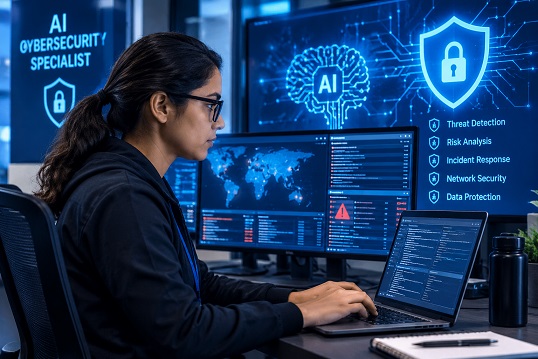
An AI cybersecurity specialist uses artificial intelligence to help protect computer systems, networks, applications, and data from cyber threats. They develop, manage, and improve AI-powered security tools that can detect suspicious activity, identify vulnerabilities, respond to attacks, and help organizations strengthen their overall cybersecurity defenses.
AI cybersecurity specialists work in technology companies, financial institutions, government agencies, healthcare organizations, consulting firms, and cybersecurity companies. They collaborate with security analysts, AI engineers, data scientists, and IT teams to monitor threats and improve security systems. Important skills for this role include cybersecurity knowledge, problem-solving, data analysis, programming, and an understanding of AI and machine learning technologies.
Duties and Responsibilities
An AI cybersecurity specialist has a variety of duties and responsibilities focused on protecting systems, networks, and data using AI-powered technologies and security practices.
- Threat Detection and Monitoring: Use AI-powered tools to identify suspicious activity, cyber threats, and potential security breaches. Continuously monitor systems and networks for signs of malicious behavior.
- Security Incident Response: Investigate cybersecurity incidents and help contain threats when they occur. Work with security teams to minimize damage and restore affected systems.
- AI Security Tool Development: Develop, implement, or manage AI-driven security solutions that improve threat detection and response. These tools help automate security processes and improve efficiency.
- Vulnerability Assessment: Identify weaknesses in systems, applications, and networks that could be exploited by attackers. Recommend and support measures to reduce security risks.
- Cyber Threat Analysis: Analyze emerging cyber threats, attack techniques, and threat intelligence data. Use findings to improve security strategies and strengthen defenses.
- Collaboration and Security Improvement: Work closely with cybersecurity professionals, AI engineers, IT teams, and business leaders. Help develop policies, procedures, and technologies that enhance overall security.
Types of AI Cybersecurity Specialists
AI cybersecurity specialists can focus on different areas of security depending on the technologies they work with and the types of threats they help defend against.
- AI Threat Detection Specialist: Uses AI systems to identify unusual activity, malware, and cyberattacks in real time. These specialists help organizations detect threats more quickly and accurately.
- AI Security Operations Specialist: Works within security operations centers (SOCs) to monitor systems and respond to security incidents. They use AI-powered tools to improve threat monitoring and incident response.
- AI Malware Analysis Specialist: Studies malicious software and uses AI technologies to detect, classify, and analyze malware threats. Their work helps improve an organization's ability to defend against evolving attacks.
- AI Vulnerability Management Specialist: Focuses on identifying, assessing, and prioritizing security weaknesses in systems and applications. They use AI tools to help automate vulnerability detection and risk assessment.
- AI Security Automation Specialist: Develops and manages automated security processes powered by AI. These specialists help reduce manual work and improve the speed of security operations.
- AI Threat Intelligence Specialist: Analyzes cyber threat data, attack patterns, and emerging risks using AI technologies. Their insights help organizations strengthen defenses and prepare for future threats.
Workplace of an AI Cybersecurity Specialist
The workplace of an AI cybersecurity specialist is typically found in technology companies, cybersecurity firms, financial institutions, healthcare organizations, government agencies, and large corporations. They often work in office or remote environments where they use AI-powered security tools, monitoring systems, and data analytics platforms to help protect networks, applications, and sensitive information.
AI cybersecurity specialists work closely with cybersecurity analysts, security engineers, AI developers, data scientists, IT professionals, and business leaders. They collaborate to identify threats, investigate security incidents, improve defenses, and develop strategies to protect organizational systems. Strong teamwork and communication skills are important because security issues often require coordination across multiple departments.
The work is fast-paced, analytical, and focused on problem-solving. AI cybersecurity specialists spend time monitoring for threats, analyzing security data, testing defenses, and responding to potential attacks. Because cyber threats and AI technologies are constantly evolving, they must continuously learn about new security risks, tools, and industry best practices.
How to become an AI Cybersecurity Specialist
Becoming an AI cybersecurity specialist requires a combination of cybersecurity expertise, technical skills, and knowledge of AI technologies used to detect and respond to threats.
- Earn a Relevant Degree: Start with a Bachelor's Degree in Cybersecurity, Computer Science, Information Technology, Data Science, or a related field. This provides a strong foundation in security principles, networking, and computing systems.
- Build Cybersecurity Knowledge: Learn about network security, threat detection, incident response, ethical hacking, and risk management. Understanding how cyberattacks occur is essential for protecting systems effectively.
- Develop AI and Machine Learning Skills: Gain experience with machine learning, data analysis, programming, and AI tools. Understanding how AI models work helps you apply them to cybersecurity challenges.
- Learn Security Tools and Technologies: Become familiar with security information and event management (SIEM) platforms, intrusion detection systems, endpoint protection tools, and threat intelligence platforms. These tools are commonly used in modern cybersecurity environments.
- Gain Hands-On Experience: Seek internships, labs, cybersecurity competitions, or entry-level security roles. Practical experience helps you apply both cybersecurity and AI concepts to real-world situations.
- Stay Current with Emerging Threats: Cybersecurity and AI evolve rapidly, so continuous learning is essential. Follow industry news, research, and best practices to stay informed about new threats, technologies, and defense strategies.
Certifications
Professional certifications can help AI cybersecurity specialists build expertise in cybersecurity, threat detection, cloud security, and AI-powered security technologies.
- Certified Information Systems Security Professional (CISSP): A globally recognized certification that validates advanced knowledge of cybersecurity strategy, risk management, and security operations.
- Certified Ethical Hacker (CEH): Focuses on ethical hacking, penetration testing, vulnerability assessment, and understanding how attackers exploit systems.
- Microsoft Certified: Cybersecurity Architect Expert: Demonstrates expertise in designing and implementing cybersecurity strategies, architectures, and security solutions across enterprise environments.
- Google Cloud Professional Cloud Security Engineer: Validates the ability to design, implement, and manage secure cloud environments while protecting systems and data.
Skills Needed for an AI Cybersecurity Specialist
- AI & Machine Learning – Understanding AI, machine learning, anomaly detection, and predictive threat analysis.
- Cybersecurity Fundamentals – Knowledge of networks, firewalls, encryption, malware, and intrusion detection.
- Programming Skills – Proficiency in Python and familiarity with languages such as Java, C++, or JavaScript.
- Threat Detection & Analysis – Ability to identify suspicious activity and detect potential cyberattacks.
- Data Analysis – Analyze large datasets and recognize patterns that may indicate security threats.
- Cloud Security – Understanding security practices for AWS, Microsoft Azure, and Google Cloud.
- Threat Intelligence – Keeping up with emerging cyber threats, vulnerabilities, and attack techniques.
- Incident Response – Quickly investigate, contain, and respond to cybersecurity incidents.
- Problem-Solving – Find effective solutions to complex security problems.
- Critical Thinking – Evaluate risks and make informed security decisions.
- Attention to Detail – Identify unusual behavior, vulnerabilities, and small security weaknesses.
- Communication Skills – Clearly explain technical security issues to teams and management.
- Adaptability & Continuous Learning – Stay updated with rapidly changing AI and cybersecurity technologies.
- Teamwork – Collaborate with cybersecurity, IT, data science, and management teams.
- Ethics & Security Awareness – Follow responsible cybersecurity practices, privacy requirements, and professional standards.
Salary of an AI Cybersecurity Specialist
The salary of an AI Cybersecurity Specialist varies by country, experience, skills, and organization.
- India: ₹6–₹25+ lakh per year
- USA: $90,000–$180,000+ per year
- UK: £45,000–£100,000+ per year
- Canada: CAD 70,000–CAD 140,000+ per year
- Australia: AUD 80,000–AUD 160,000+ per year
Entry-level: Usually lower, especially without AI and cybersecurity experience.
Mid-level: Salary increases significantly with experience in threat detection, machine learning, cloud security, and incident response.
Senior/Expert: Professionals combining advanced AI, cybersecurity, and leadership skills can earn substantially higher salaries.








User's Comments
No comments there.