


Stories you may like
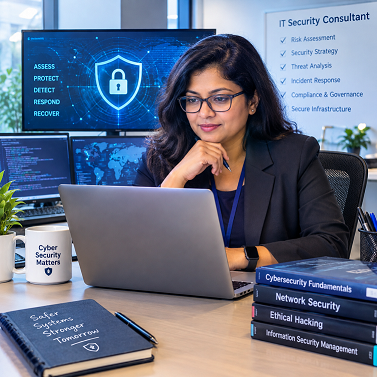
IT Security Consultant
An IT security consultant provides expert advice and guidance on information technology security matters to organizations. Their primary role is to assess an organization's IT infrastructure, systems, and processes to identify vulnerabilities, assess risks, and recommend appropriate security measures. IT security consultants work closely with clients to understand their specific security needs and goals and develop customized strategies to enhance their overall security posture.
IT security consultants perform a range of tasks, including conducting security assessments and audits, developing security policies and procedures, designing and implementing security solutions, and providing ongoing monitoring and support. They have a deep understanding of cybersecurity principles, industry best practices, and regulatory requirements. They stay updated with emerging threats and trends in the field of IT security to effectively advise clients on the most effective security measures to protect their digital assets. Additionally, IT security consultants may also assist with incident response planning, employee training, and security awareness programs to promote a culture of security within organizations.
What does an IT Security Consultant do?
IT security consultants play a vital role in helping organizations protect their information assets, maintain regulatory compliance, and mitigate risks associated with cyber threats.
Duties and Responsibilities
The duties and responsibilities of an IT security consultant can vary depending on the specific organization and project, but here are some common tasks associated with the role:
- Security Assessments: Conduct comprehensive assessments of an organization's IT infrastructure, systems, and processes to identify vulnerabilities, assess risks, and evaluate the effectiveness of existing security controls. This may involve performing penetration testing, vulnerability scanning, and security audits.
- Security Strategy and Planning: Develop customized security strategies and roadmaps based on the organization's specific needs, industry regulations, and best practices. This includes defining security objectives, establishing security policies and procedures, and creating incident response and disaster recovery plans.
- Security Solutions Implementation: Design and implement security solutions and technologies to protect against cyber threats and address identified vulnerabilities. This may involve configuring firewalls, implementing intrusion detection and prevention systems (IDPS), deploying encryption mechanisms, and ensuring secure network architecture.
- Security Policy Development: Assist in the development and implementation of security policies, standards, and guidelines that align with industry regulations and best practices. This includes defining access control measures, data classification and handling, and user awareness training programs.
- Risk Management: Identify and assess potential risks and provide recommendations for risk mitigation. This involves evaluating the likelihood and impact of security incidents, implementing risk management frameworks, and conducting risk assessments to prioritize security investments.
- Incident Response and Forensics: Develop incident response plans and procedures to effectively respond to and manage security incidents. IT security consultants may also be involved in conducting digital forensics investigations to identify the root causes of security breaches and support legal proceedings if necessary.
- Security Awareness and Training: Educate employees and stakeholders about security best practices, policies, and procedures to promote a culture of security within the organization. This includes conducting training sessions, creating security awareness campaigns, and providing guidance on safe computing practices.
- Stay Updated with Industry Trends: Continuously monitor emerging cybersecurity threats, technologies, and industry trends. IT security consultants stay informed about the latest security vulnerabilities, attack techniques, and regulatory changes to provide up-to-date advice and recommendations to clients.
Typs of IT Security Consultants
There are various types of IT security consultants who specialize in different areas of information technology security. Here are some common types:
- Network Security Consultant: Network security consultants focus on securing an organization's network infrastructure. They assess network architecture, design and implement security controls, configure firewalls, intrusion detection systems (IDS), and virtual private networks (VPNs), and ensure secure network segmentation and access controls.
- Application Security Consultant: Application security consultants specialize in securing software applications. They conduct security assessments of applications, perform secure code reviews, and provide recommendations to address vulnerabilities and ensure secure coding practices. They may also assist in implementing secure software development lifecycle (SDLC) processes.
- Cloud Security Consultant: Cloud security consultants specialize in securing cloud-based environments and services. They assess cloud infrastructure, configurations, and access controls to ensure compliance and protect against cloud-specific risks. They provide guidance on implementing security measures and best practices in cloud environments.
- Compliance and Regulatory Consultant: Compliance and regulatory consultants focus on helping organizations meet industry-specific security requirements and regulatory frameworks. They assess the organization's compliance posture, provide guidance on meeting regulatory obligations, and assist in developing policies and procedures to ensure compliance with standards such as PCI DSS, HIPAA, GDPR, or ISO 27001.
- Incident Response Consultant: Incident response consultants specialize in helping organizations respond to and manage security incidents. They develop incident response plans, conduct investigations to identify the root cause of incidents, perform digital forensics analysis, and provide guidance on incident containment, eradication, and recovery.
- Risk and Governance Consultant: Risk and governance consultants help organizations assess and manage risks related to information security. They perform risk assessments, develop risk management frameworks, and provide guidance on risk mitigation strategies. They also assist in establishing security governance frameworks and policies.
- Security Architecture Consultant: Security architecture consultants focus on designing and implementing secure information security architectures for organizations. They develop security reference architectures, define security controls, and provide guidance on secure system and network design.
What is the workplace of an IT Security Consultant like?
Many IT security consultants spend a significant amount of time at client sites. They work directly with clients, visiting their corporate offices, data centers, or other locations where the client's IT infrastructure and systems are situated. Being on-site allows consultants to understand the client's environment, conduct assessments, collaborate with the client's IT team, and provide hands-on assistance in implementing security measures. This setup enables consultants to gain firsthand knowledge of the client's systems and work closely with the client to address their specific security needs.
Some IT security consultants are employed by consulting firms or work as independent contractors. In these cases, their workplace is often the consulting firm's office. These offices typically foster a collaborative and dynamic environment, where consultants work alongside colleagues on various client projects. Consulting firms may have specialized labs and resources to support security assessments, research, and solution development. Consultants in this setting have the advantage of working with a diverse team, sharing knowledge and expertise, and leveraging the resources provided by the firm.
With the increasing trend of remote work, many IT security consultants have the flexibility to work remotely or have a hybrid work arrangement. They may work from home or other locations while collaborating with clients and colleagues virtually. This virtual work environment allows for increased flexibility but also requires strong communication and collaboration skills to effectively engage with clients and project teams. Travel may be required for some IT security consultants, particularly when visiting client locations in different cities or countries to provide on-site support, conduct security assessments, or deliver training sessions.
In terms of work hours, IT security consultants often have flexible schedules that align with project deadlines and client needs. They may need to work outside regular business hours during critical incidents or when urgent security matters arise. Continuous learning is also essential in this field, and consultants may spend time staying updated with the latest security trends, attending conferences, or pursuing professional development activities.
How to become an IT Security Consultant
To become an IT security consultant, there are several steps you can take:
- Obtain a relevant educational background: Pursue a bachelor's or master's degree in a field related to information technology, computer science, cybersecurity, or a similar discipline. This provides a strong foundation of knowledge and skills in areas such as network security, systems administration, programming, and risk management.
- Gain practical experience: Acquire hands-on experience in IT and cybersecurity through internships, entry-level positions, or volunteer opportunities. This allows you to apply your knowledge in real-world scenarios, gain exposure to different technologies and systems, and develop problem-solving skills.
- Build a strong technical skill set: Develop expertise in areas such as network security, cloud security, application security, risk assessment, and incident response. Obtain certifications relevant to IT security, such as Certified Information Systems Security Professional (CISSP), Certified Ethical Hacker (CEH), Certified Information Security Manager (CISM), or Certified Information Systems Auditor (CISA).
- Develop a deep understanding of cybersecurity frameworks and regulations: Familiarize yourself with industry standards and frameworks such as ISO 27001, NIST Cybersecurity Framework, and COBIT. Understand regulatory requirements, such as the General Data Protection Regulation (GDPR) and industry-specific compliance standards like Payment Card Industry Data Security Standard (PCI DSS).
- Expand your knowledge through continuous learning: Stay updated with the latest trends, emerging threats, and advancements in IT security. Attend industry conferences, participate in webinars and workshops, and join professional organizations and communities to network with other professionals and share knowledge.
- Hone your communication and consulting skills: Effective communication is essential as an IT security consultant. Develop strong verbal and written communication skills to effectively convey complex technical concepts to clients and stakeholders. Enhance your consulting skills by learning how to assess client needs, develop tailored security strategies, and deliver effective recommendations.
- Gain professional experience: Work in IT security roles such as a cybersecurity analyst, network security engineer, or IT auditor to gain practical experience and build a track record of success. This demonstrates your expertise and credibility when seeking consulting opportunities.
- Seek opportunities in consulting firms or start your own consultancy: Apply for positions at consulting firms specializing in IT security or consider starting your own consultancy. Networking, attending industry events, and building relationships with professionals in the field can help you uncover consulting opportunities.
Certifications
There are several certifications that can enhance the qualifications and credibility of IT security consultants. Some of the widely recognized certifications in the field of IT security include:
- Certified Information Systems Security Professional (CISSP): Offered by (ISC)², CISSP is a globally recognized certification that validates expertise in various domains of information security, including security and risk management, asset security, security engineering, and more.
- Certified Ethical Hacker (CEH): Provided by the EC-Council, the CEH certification demonstrates knowledge and skills in identifying vulnerabilities and applying ethical hacking techniques to assess and strengthen an organization's security posture.
- Certified Information Security Manager (CISM): Offered by ISACA, the CISM certification is designed for information security management professionals. It validates skills in managing, designing, and assessing an enterprise's information security program.
- Certified Information Systems Auditor (CISA): Also provided by ISACA, the CISA certification focuses on auditing, controlling, monitoring, and assessing information systems and provides assurance of an individual's expertise in IT governance and risk management.
- Offensive Security Certified Professional (OSCP): Offered by Offensive Security, the OSCP certification is highly regarded in the field of penetration testing. It assesses practical skills in identifying vulnerabilities, exploiting systems, and effectively documenting findings.
- Certified Cloud Security Professional (CCSP): Provided by (ISC)², the CCSP certification validates knowledge and expertise in cloud security, including cloud architecture, operations, and legal and compliance aspects.
- Certified Information Privacy Professional (CIPP): Offered by the International Association of Privacy Professionals (IAPP), the CIPP certification focuses on privacy laws, regulations, and best practices, demonstrating expertise in managing and protecting personal information.
- Certified Incident Handler (GCIH): Provided by the SANS Institute, the GCIH certification validates skills in incident handling, response techniques, and investigation methods to effectively manage and mitigate security incidents.











User's Comments
No comments there.