


Stories you may like
AI Accessibility Designer
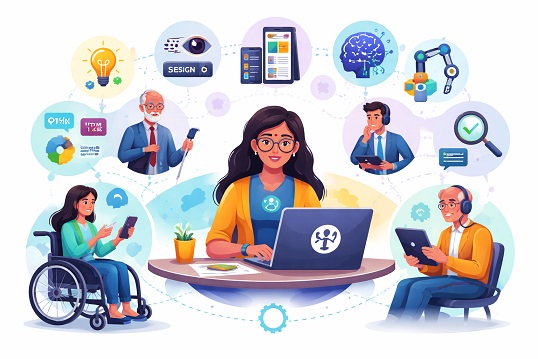
An AI accessibility designer makes AI-powered products and experiences usable for everyone, including people with disabilities. They focus on creating inclusive features for voice assistants, chatbots, recommendation systems, and other AI tools, ensuring that interactions are clear, fair, and easy to navigate. By considering a wide range of user needs, these designers help AI systems work well for people with visual, hearing, cognitive, or mobility challenges.
AI accessibility designers often collaborate with UX designers, engineers, and product teams to build accessible interfaces and workflows. They apply accessibility standards, test designs with real users, and adjust AI behaviors to reduce bias and improve clarity. Their work helps ensure that AI technologies are not only functional but also welcoming, fair, and effective for a diverse audience.
An AI accessibility designer focuses on making AI tools and experiences usable for everyone, including people with disabilities. Their work helps ensure that technology is inclusive, fair, and easy to interact with. Here are some key responsibilities:
- Designing Inclusive AI Experiences: They create interfaces and interactions that work for people with a wide range of abilities. This includes supporting tools like screen readers, voice commands, and other assistive technologies.
- Testing for Accessibility Issues: They regularly test AI systems to identify barriers that could make them difficult to use. This might include checking for poor contrast, confusing layouts, or features that don’t work with assistive tools.
- Improving Usability for All Users: They simplify instructions, navigation, and AI responses to make them easier to understand. Their goal is to create experiences that feel clear and intuitive for as many people as possible.
- Collaborating with Developers and Designers: They work closely with product teams to ensure accessibility is built into the design from the beginning. This helps prevent issues instead of fixing them later.
- Following Accessibility Standards: They apply established guidelines, such as WCAG, to guide their work. These standards help ensure consistency and quality across digital products.
- Advocating for Inclusive Design: They raise awareness about accessibility within teams and organizations. They help others understand why inclusive design benefits everyone, not just specific groups.
- Reviewing AI Outputs for Clarity and Bias: They evaluate AI-generated content to make sure it is easy to understand. They also look for language or patterns that could unintentionally exclude or disadvantage certain users.
Workplace of an AI Accessibility Designer
The workplace of an AI accessibility designer is usually a modern office environment, but it is often flexible and hybrid. Many professionals in this role work part of the time in an office and part of the time from home. Their work is mostly done on a computer, using design tools, testing software, and collaboration platforms.
A big part of their day involves working with other teams, such as product managers, engineers, UX designers, and researchers. They join meetings to review designs, discuss accessibility issues, and suggest improvements. They also spend time testing AI products to make sure they work well with assistive technologies like screen readers or voice control.
The environment is usually collaborative and detail-focused, with a strong emphasis on problem-solving and communication. Deadlines can be tied to product launches or updates, so the work can sometimes be fast-paced. At the same time, there is a strong focus on thoughtful design, making sure AI tools are usable and inclusive for as many people as possible.
Skills
1. Accessibility Knowledge
- Understanding of inclusive design principles
- Familiarity with standards like Web Content Accessibility Guidelines (WCAG)
- Knowledge of assistive technologies (screen readers, voice control, etc.)
- Awareness of different disabilities (visual, hearing, motor, cognitive)
2. UX/UI Design Skills
- User-centered design thinking
- Wireframing and prototyping (using tools like Figma, Adobe XD)
- Designing intuitive, simple, and flexible interfaces
- Conducting usability testing with diverse users
3. Basic AI & Machine Learning Understanding
- Understanding how AI models work (chatbots, voice assistants, recommendation systems)
- Awareness of bias in AI systems
- Ability to collaborate with AI engineers and data scientists
- Familiarity with tools like TensorFlow or PyTorch (basic level is enough)
4. Front-End Development Basics
- Knowledge of HTML, CSS, JavaScript
- Ability to implement accessible components (ARIA roles, semantic HTML)
- Understanding responsive and adaptive design
5. Communication & Empathy
- Strong empathy for users with disabilities
- Ability to conduct interviews and gather feedback
- Clear communication with cross-functional teams
6. Testing & Evaluation Skills
- Accessibility auditing tools (like WAVE, axe DevTools)
- Manual testing with assistive tech
- Identifying and fixing accessibility barriers
7. Ethical & Legal Awareness
- Understanding of accessibility laws (like ADA, etc.)
- Knowledge of ethical AI practices (fairness, transparency)
- Privacy considerations for users with disabilities
8. Problem-Solving & Innovation
- Designing creative solutions for accessibility challenges
- Adapting AI systems to different user needs
- Continuous learning as technology evolves
Bonus Skills
- Voice UI / Conversational design
- Knowledge of speech recognition and text-to-speech systems
- Data annotation for inclusive AI training
AI Accessibility Designer Salary (India – 2026)
Entry Level (0–2 years)
- ₹5 LPA – ₹10 LPA
- If you have strong UX + accessibility portfolio → can reach ₹8–12 LPA
Fresh UX designers typically start around ₹5 LPA
Mid-Level (3–6 years)
- ₹10 LPA – ₹20 LPA
- With AI + accessibility specialization → higher demand
Average AI designer salary ≈ ₹10 LPA
Senior Level (7+ years)
- ₹20 LPA – ₹35 LPA+
- Lead roles (AI Product Designer / Accessibility Lead)
AI product designers average ~₹14–22 LPA, top roles higher
Top Companies / Experts
- ₹30 LPA – ₹50 LPA+
- Especially in:
Product companies (Google, Microsoft, startups)
AI-focused companies
Advanced AI professionals can earn ₹25–45+ LPA










User's Comments
No comments there.