


Stories you may like
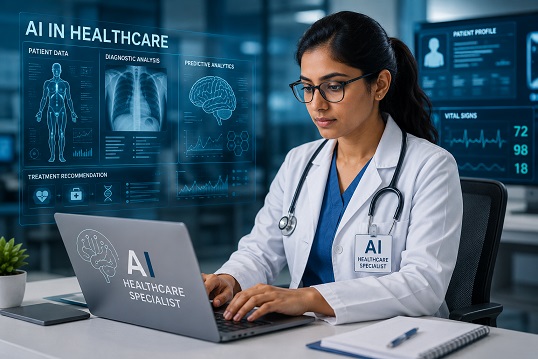
AI Healthcare Specialist
An AI healthcare specialist uses artificial intelligence (AI) to help improve healthcare. They work with doctors, hospitals, clinics, and healthcare companies to create or manage AI tools that can assist with tasks like finding diseases earlier, organizing patient information, predicting health risks, or helping doctors make decisions faster. For example, AI can analyze medical images such as X-rays or MRIs to help spot problems that might be difficult for humans to notice quickly.
These specialists usually understand both healthcare and technology. Some come from medical backgrounds, while others are trained in computer science or data analysis. Their job is to make sure AI systems are accurate, safe, and useful for patients and healthcare workers. As AI becomes more common in healthcare, AI healthcare specialists are becoming important in areas like hospitals, medical research, wearable health technology, and digital health companies.
Duties and Responsibilities
The duties and responsibilities of an AI healthcare specialist can be diverse and may vary depending on the healthcare organization, technology used, and specific role. However, some common tasks and responsibilities include:
- AI System Development: Designing and helping develop AI tools that support healthcare services, such as diagnostic software, patient monitoring systems, or virtual health assistants. These systems are created to improve efficiency, accuracy, and patient care in hospitals and clinics.
- Data Analysis and Management: Collecting, organizing, and analyzing healthcare data such as patient records, medical images, and test results. They also ensure that the data is accurate, secure, and suitable for training AI systems.
- Machine Learning Model Support: Assisting in the creation and testing of machine learning models used to predict diseases, recommend treatments, or identify health risks. They monitor these models to make sure they continue to perform correctly and safely.
- Healthcare Technology Integration: Working with healthcare professionals to integrate AI tools into existing medical systems and workflows. This helps doctors, nurses, and staff use the technology effectively in daily patient care.
- Research and Innovation: Staying up-to-date with new AI technologies, healthcare trends, and medical research. They may also help develop new AI solutions that improve healthcare services and patient outcomes.
- Ethics and Compliance: Ensuring AI systems follow healthcare laws, privacy regulations, and ethical guidelines. They help protect patient information and make sure AI tools are used responsibly and fairly.
Types of AI Healthcare Specialists
AI healthcare specialists can specialize in different areas depending on the type of technology they work with and the healthcare problems they help solve. Here are some common types of AI healthcare specialists based on their areas of expertise:
- Medical Imaging Specialist: Focuses on using AI to analyze medical images such as X-rays, MRIs, CT scans, and ultrasounds. They help develop systems that can detect diseases and abnormalities more quickly and accurately.
- Healthcare Data Analyst: Specializes in collecting and analyzing healthcare data to identify patterns, trends, and risks. They use AI tools to support decision-making, improve patient care, and increase hospital efficiency.
- Clinical AI Specialist: Works closely with doctors and healthcare teams to implement AI tools in clinical settings. They help ensure AI systems support patient diagnosis, treatment planning, and overall healthcare operations.
- Natural Language Processing (NLP) Specialist: Develops AI systems that can understand and process medical language from doctor notes, patient records, and healthcare documents. These systems help organize information and improve communication within healthcare organizations.
- AI Research Scientist: Conducts research to create new AI technologies and improve existing healthcare AI systems. They often work in universities, hospitals, or technology companies to advance medical innovation.
- Healthcare Robotics Specialist: Designs and manages robotic systems used in healthcare environments, such as surgical robots or patient care assistants. They combine AI and robotics to improve precision, safety, and efficiency in medical procedures.
Workplace of an AI Healthcare Specialist
The workplace of an AI healthcare specialist is usually a mix of healthcare and technology environments. They may work in hospitals, clinics, research centers, healthcare technology companies, universities, or large medical organizations. Some specialists work directly with doctors and healthcare staff, while others work mainly with software developers, engineers, and data analysts to create and improve AI systems.
Their daily work often involves using computers, analyzing healthcare data, testing AI programs, and solving technical problems. AI healthcare specialists may spend time reviewing patient data, improving machine learning models, or helping healthcare teams use new technology. They also attend meetings, collaborate with different departments, and stay updated on new medical and AI developments.
Many AI healthcare specialists work in modern office settings or remotely, especially when their work focuses on software development and data analysis. In healthcare environments, they may also spend time in hospitals or laboratories to better understand how AI tools are used in patient care. The job usually combines teamwork, problem-solving, and continuous learning because healthcare technology changes quickly.
How to become an AI Healthcare Specialist
Becoming an AI healthcare specialist involves building knowledge in both healthcare and artificial intelligence technologies. Here’s a guide to help you navigate the path toward this career:
- Educational Background: Obtain a strong educational foundation by earning a bachelor’s degree in a relevant field such as computer science, data science, biomedical engineering, or information technology. Some professionals also continue with specialized certifications or graduate studies in artificial intelligence or healthcare technology.
- Learn Programming and Technology Skills: Develop skills in programming languages commonly used in AI, such as Python, Java, or R. Gain experience with databases, software systems, and data analysis tools that are often used in healthcare environments.
- Understand Artificial Intelligence Fundamentals: Learn the basics of artificial intelligence, machine learning, and data analytics. Study topics such as predictive modeling, neural networks, and healthcare data processing to understand how AI supports medical decision-making.
- Build Healthcare Knowledge: Become familiar with healthcare systems, medical terminology, patient care processes, and healthcare regulations. Understanding the healthcare industry helps specialists create AI tools that are practical, safe, and useful for medical professionals.
- Gain Practical Experience: Participate in internships, research projects, or entry-level positions related to healthcare technology or AI development. Hands-on experience helps build technical skills and provides exposure to real-world healthcare challenges.
- Stay Updated and Continue Learning: Keep up with new developments in AI, healthcare technology, and medical research. Continuous learning through courses, workshops, certifications, and industry events is important because both healthcare and AI evolve rapidly.
Certifications
There are several certifications that can help individuals develop the technical and healthcare knowledge needed to become an AI healthcare specialist. These certifications can improve skills in artificial intelligence, healthcare technology, data analysis, and machine learning:
- Certified Artificial Intelligence Practitioner (CAIP): This certification focuses on the fundamentals of artificial intelligence, machine learning, and data science. It helps learners build practical AI skills that can be applied in healthcare and other industries.
- Microsoft Certified: Azure AI Engineer Associate: This certification demonstrates the ability to build and manage AI solutions using Microsoft Azure tools and services. It is useful for professionals working with healthcare AI systems, cloud computing, and data management.
- IBM AI Engineering Professional Certificate: This program teaches machine learning, deep learning, and AI model development using real-world projects. It helps learners gain practical experience with technologies commonly used in healthcare AI applications.
- Certified Professional in Healthcare Information and Management Systems (CPHIMS): This certification focuses on healthcare information systems, technology management, and digital healthcare solutions. It is valuable for individuals who want to combine healthcare knowledge with AI and technology skills.
- TensorFlow Developer Certificate: This certification demonstrates the ability to build and train machine learning models using TensorFlow, a popular AI framework. It helps professionals develop technical skills used in medical data analysis and healthcare AI tools.
- AWS Certified Machine Learning – Specialty: This certification focuses on designing and deploying machine learning solutions using Amazon Web Services (AWS). It is useful for professionals working with large healthcare datasets, predictive analytics, and cloud-based AI systems.
Skills Needed for an AI Healthcare Specialist
An AI Healthcare Specialist combines healthcare knowledge with artificial intelligence, data analysis, and digital health technologies to help develop, evaluate, and implement AI solutions in healthcare. Current competency frameworks emphasize AI fundamentals, data skills, clinical application, ethics, evaluation, communication, and workflow integration.
1. AI & Machine Learning Knowledge
- Understanding of Artificial Intelligence and Machine Learning
- Knowledge of supervised and unsupervised learning
- Understanding of deep learning and generative AI
- Ability to understand how healthcare AI models produce predictions
- Familiarity with AI tools used for diagnosis, risk prediction, medical imaging, and clinical decision support
2. Healthcare & Clinical Knowledge
- Understanding of healthcare terminology and clinical workflows
- Knowledge of patient care processes
- Understanding of medical records and clinical data
- Ability to identify appropriate healthcare problems for AI solutions
- Understanding of the limitations of AI in clinical decision-making
AI specialists working in healthcare need to understand both the technology and the clinical environment so that AI is used safely and appropriately.
3. Data Analysis Skills
- Data collection and preparation
- Data cleaning and preprocessing
- Statistical analysis
- Data visualization
- Healthcare database management
- Understanding of structured and unstructured medical data
- Ability to identify missing, inaccurate, or biased data
Data quality, representativeness, governance, and interoperability are particularly important because healthcare AI depends heavily on reliable health datasets.
4. Programming & Technical Skills
- Python or R
- SQL and database management
- Basic machine-learning libraries
- Data analytics tools
- APIs and healthcare software integration
- Familiarity with electronic health record systems
- Understanding of healthcare interoperability standards such as FHIR
5. AI Model Evaluation
An AI Healthcare Specialist should be able to:
- Evaluate accuracy and reliability
- Understand sensitivity and specificity
- Interpret model performance metrics
- Detect bias and errors
- Assess whether a model has been properly validated
- Monitor performance after deployment
- Recognize problems such as data drift and AI hallucinations
Evidence-based evaluation of an AI system's accuracy, safety, contextual appropriateness, and bias is considered a core healthcare AI competency.
6. Ethics, Privacy & Legal Knowledge
- Patient confidentiality
- Health-data privacy
- Data security
- Informed consent
- AI ethics
- Algorithmic bias and fairness
- Transparency and explainability
- Healthcare regulations
- Responsible AI governance
WHO emphasizes that health data used for AI should be ethically sourced, representative, appropriately governed, and protected against privacy risks.
7. Clinical AI & Decision Support
- Using AI-assisted clinical decision-support systems
- Interpreting AI-generated recommendations
- Understanding uncertainty in AI predictions
- Combining AI outputs with clinical evidence
- Supporting patient-centered care
- Knowing when not to rely on an AI recommendation
AI should support professional healthcare judgment rather than replace responsible clinical decision-making.
8. Communication & Teamwork
- Clear communication with doctors and nurses
- Working with data scientists and software engineers
- Explaining technical AI concepts to non-technical healthcare staff
- Communicating AI risks to patients
- Interdisciplinary collaboration
- Training healthcare workers to use AI systems
9. Problem-Solving & Critical Thinking
- Identifying healthcare problems that AI can realistically address
- Comparing different AI solutions
- Detecting weaknesses in AI-generated results
- Troubleshooting AI implementation problems
- Making evidence-based decisions
- Balancing technological benefits against patient safety
10. Digital Health & Workflow Skills
- Understanding digital health systems
- Integrating AI into existing healthcare workflows
- Identifying how AI changes staff responsibilities
- Managing implementation and adoption
- Understanding telemedicine and remote-care technologies
- Supporting digital transformation projects
Current WHO digital-health competency work highlights patient care, data, informatics, communication, technical proficiency, digital professionalism, and administration as major competency areas.
11. Continuous Learning
AI and healthcare technologies change rapidly, so specialists should continuously develop their knowledge of:
- New AI models and tools
- Medical AI research
- Healthcare regulations
- Data-protection requirements
- Emerging digital-health technologies
- New clinical applications of AI
Salary of an AI Healthcare Specialist
The salary of an AI Healthcare Specialist varies considerably depending on experience, technical skills, healthcare knowledge, location, and employer. Since the job title is still emerging, salaries are often reported under related titles such as Clinical AI Specialist, Healthcare AI Specialist, Health Informatics Specialist, or AI/ML Specialist.
India
A Rajasthan government career profile estimates ₹6 lakh–₹40 lakh per year for an AI Healthcare Specialist, with higher salaries possible in senior management and leadership positions.
For related HealthTech roles, a 2025–26 India Pharma & HealthTech talent report gives indicative compensation of approximately:
- Data Scientist / ML Engineer: ₹15–15.8 lakh for 0–2 years
- Data Scientist / ML Engineer: ₹30–31.5 lakh for 3–7 years
- Data Scientist / ML Engineer: ₹45–47.3 lakh for 8–12 years
- Health Informatics Specialist: ₹20–21 lakh for 3–7 years
- Health Informatics Specialist: ₹35–36.8 lakh for 8–12 years
So, in India, a realistic career range for AI-healthcare professionals can be roughly ₹6 lakh to ₹40+ lakh per year, depending strongly on specialization and seniority.
United States
For Clinical AI Specialists, current 2026 salary data shows an average of about $69,454 per year, with most salaries falling between approximately $45,000 and $83,000. Higher earners can exceed $110,000.
Broader Healthcare AI roles average around $77,368 per year, with most salaries between approximately $59,500 and $98,000.
More technically focused AI/ML Specialist positions have a substantially higher average of about $119,383 per year.
United Kingdom
Health informatics specialists commonly earn around £30,000–£50,000, while senior specialists can earn £60,000–£70,000+.
For dedicated Healthcare AI Lead positions, 2026 estimates range from approximately £50,000–£70,000 at junior level, £70,000–£100,000 at mid-level, and £100,000–£150,000 at senior level.
Overall Salary Potential
AI Healthcare Specialist: approximately ₹6 lakh–₹40+ lakh/year in India, $45,000–$120,000+ in the USA, and £30,000–£150,000+ in the UK, depending on the specific role and experience.
Senior AI healthcare leaders, AI/ML specialists, and professionals combining clinical expertise with advanced AI skills can earn considerably more.










User's Comments
No comments there.