


Stories you may like
AI Trust & Safety Specialist
An AI trust & safety specialist helps make sure artificial intelligence systems are safe to use, follow rules, and do not produce harmful or misleading content. They focus on protecting users by reducing risks such as misinformation, bias, harassment, privacy issues, and unsafe AI outputs. Their work often involves reviewing AI behavior, setting safety guidelines, and helping improve systems so they act more responsibly.
AI trust & safety specialists work in technology companies, social media platforms, AI research labs, and organizations that build or use AI systems. They collaborate with engineers, data scientists, policy teams, and legal experts to monitor AI performance and improve safety standards. Important skills for this role include critical thinking, attention to detail, communication, and a strong understanding of how AI systems generate and process information.
Duties and Responsibilities
An AI trust & safety specialist has a range of duties and responsibilities focused on keeping AI systems safe, reliable, and appropriate for users.
- Content Safety Monitoring: Review AI outputs to identify harmful, misleading, or inappropriate content. Flag issues such as misinformation, hate speech, harassment, or unsafe responses.
- Policy Development and Enforcement: Help create and apply trust and safety guidelines for how AI systems should behave. Ensure AI tools follow internal rules and community standards.
- Risk Identification and Analysis: Detect potential risks in AI behavior, including bias, privacy issues, or ways users might misuse the system. Analyze patterns to prevent future problems.
- Safety Testing and Evaluation: Test AI systems under different scenarios to see how they respond to sensitive or high-risk prompts. Evaluate whether safeguards are working effectively.
- Incident Response Support: Investigate and respond to safety issues when they occur. Work with teams to fix problems and prevent them from happening again.
- Cross-Team Collaboration: Work with AI engineers, product teams, policy experts, and legal staff to improve system safety. Share findings and recommend improvements based on real-world use.
Types of AI Trust & Safety Specialists
AI trust & safety specialists can focus on different areas depending on the platform, type of AI system, and the risks they are responsible for managing.
- Content Moderation Trust & Safety Specialist: Focuses on reviewing AI outputs and user-generated content to ensure it follows safety guidelines. They help reduce harmful, offensive, or misleading content.
- AI Policy Trust & Safety Specialist: Develops and maintains rules and guidelines for how AI systems should behave. They work on updating policies as new risks and technologies emerge.
- AI Risk Trust & Safety Specialist: Identifies and analyzes potential risks in AI systems, such as bias, misinformation, or unsafe behavior. They help teams prevent issues before they reach users.
- Product Trust & Safety Specialist: Works directly with product teams to make sure safety features are built into AI tools. They help balance user experience with safety requirements.
- AI Integrity Trust & Safety Specialist: Focuses on detecting manipulation, fraud, or abuse of AI systems. They work to ensure AI is used honestly and responsibly.
Workplace of an AI Trust & Safety Specialist
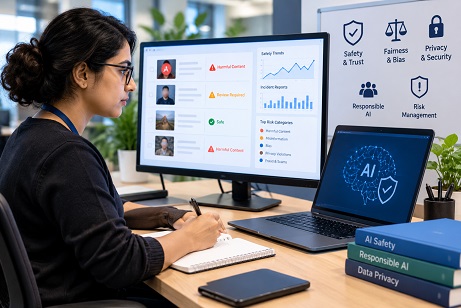
The workplace of an AI trust & safety specialist is usually in a technology company, social media platform, AI research lab, or a remote work environment. Their day-to-day work involves reviewing AI system behavior, monitoring safety issues, and making sure AI tools follow company policies and community guidelines. Much of their time is spent analyzing reports, testing AI outputs, and working with internal tools designed to track safety risks.
AI trust & safety specialists work closely with many different teams, including AI engineers, product managers, data scientists, and legal or policy teams. They often join meetings to discuss safety concerns, review new AI features, and suggest improvements before products are released to users. Clear communication is important because they help translate safety rules into practical changes in the technology.
The role is fast-paced and detail-oriented, especially when new AI features or updates are being launched. Specialists may need to respond quickly to emerging risks, investigate user complaints, or review unexpected AI behavior. Because AI systems evolve quickly, they also spend time staying updated on new safety challenges, industry standards, and best practices for responsible AI use.
How to become an AI Trust & Safety Specialist
Becoming an AI trust & safety specialist involves building knowledge of artificial intelligence systems, online safety practices, policy standards, and strong analytical skills. Here are the key steps to follow:
- Earn a Relevant Degree: Start with a Bachelor’s Degree in Computer Science, Information Technology, Communications, Psychology, Data Science, or Public Policy. This helps build a foundation in both technical systems and human behavior.
- Learn How AI Systems Work: Develop an understanding of how AI models generate outputs, including large language models, recommendation systems, and content moderation tools. Knowing how AI behaves is essential for identifying safety risks.
- Study Online Safety and Policy Frameworks: Learn about content moderation, platform safety rules, data privacy, and ethical AI principles. Understanding how platforms set and enforce rules is a key part of the role.
- Build Analytical and Communication Skills: Strengthen your ability to analyze patterns, identify risks, and clearly document findings. Communication is important because you’ll often explain issues to technical and non-technical teams.
- Gain Practical Experience: Look for entry-level roles or internships in content moderation, AI operations, policy, risk analysis, or trust and safety teams. Real-world experience helps you understand how safety systems operate in practice.
- Stay Updated on AI and Online Safety Trends: The field changes quickly, so it’s important to follow developments in AI behavior, platform safety issues, and emerging risks in digital systems.
Helpful Resources
Here are some helpful resources for learning about AI trust & safety and building knowledge in content safety, AI behavior, and online platform governance.
- AI Safety Fundamentals (BlueDot Impact): A structured introduction to AI safety concepts, including risk, alignment, and responsible AI systems.
- Trust & Safety Professional Association (TSPA): Offers industry insights, learning materials, and career guidance for trust & safety roles.
- Google Safety Center: Provides clear explanations of online safety principles, content moderation approaches, and responsible platform practices.
- Meta Transparency Center: Shares information on content moderation policies, enforcement systems, and platform safety standards.
- Papers with Code: Useful for exploring AI models and understanding how systems that trust & safety teams monitor are built and evaluated.
Skills Needed for an AI Trust & Safety Specialist
An AI Trust & Safety Specialist helps ensure that AI systems are safe, responsible, fair, and resistant to misuse. The role combines AI knowledge, risk assessment, policy, and analytical skills.
Key Skills
- AI & Machine Learning Knowledge
Understanding how AI models, generative AI, LLMs, and automated systems work. - Trust & Safety Policies
Knowledge of content moderation policies, platform rules, AI safety standards, and acceptable-use guidelines. - Risk Assessment
Ability to identify risks such as harmful content, misinformation, bias, privacy violations, fraud, and AI misuse. - Content Moderation
Ability to review and classify text, images, audio, and video according to established safety policies. - Data Analysis
Ability to analyze safety incidents, user reports, trends, and performance metrics to identify emerging risks. - Critical Thinking
Strong judgment for handling complex or ambiguous safety cases and making consistent decisions. - Ethical AI Understanding
Knowledge of AI ethics, fairness, transparency, accountability, and responsible AI practices. - Policy Development
Ability to create, update, and implement safety guidelines for AI products and services. - Knowledge of AI Threats
Awareness of prompt injection, jailbreaks, deepfakes, misinformation, scams, automated abuse, and other AI-related threats. - Communication Skills
Ability to clearly explain safety findings and recommendations to technical and non-technical teams. - Problem-Solving Skills
Ability to investigate incidents, determine root causes, and recommend effective safety improvements. - Attention to Detail
Important for accurately reviewing large volumes of potentially harmful or sensitive AI-generated content. - Privacy & Security Awareness
Understanding of data protection, user privacy, cybersecurity risks, and responsible handling of sensitive information. - Incident Response
Ability to investigate, document, escalate, and help resolve AI safety incidents. - Cross-Functional Collaboration
Ability to work with AI engineers, product managers, legal teams, policy teams, moderators, and security professionals.
AI Trust & Safety Specialist Salary
The salary of an AI Trust & Safety Specialist varies based on experience, location, employer, and technical expertise.
India
- Entry-level: ₹4–8 lakh per year
- Mid-level: ₹8–15 lakh per year
- Experienced: ₹15–25 lakh per year
- Senior/Specialist roles: ₹25–40+ lakh per year
In major technology companies and AI-focused organizations, professionals with expertise in AI safety, risk management, cybersecurity, content moderation, and responsible AI may earn at the higher end of these ranges.
United States
- Entry-level: $70,000–$100,000 per year
- Mid-level: $100,000–$150,000 per year
- Senior-level: $150,000–$220,000+ per year
Salaries can be substantially higher at leading AI and technology companies, particularly for specialists with strong technical and policy expertise.








User's Comments
No comments there.